Piko
Piko Promptu incele ↗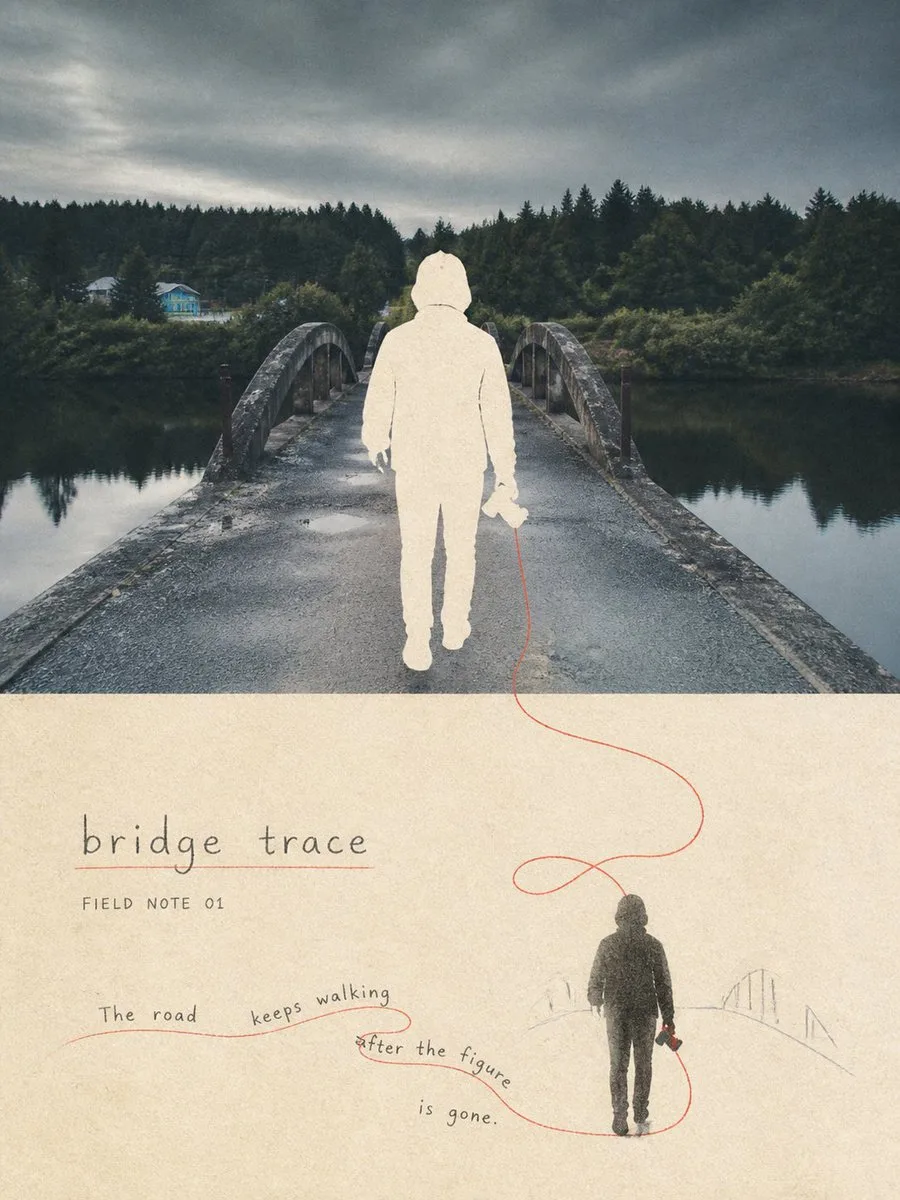
ChatGPT
TasarımChatGPT
Stitch travel memory negative space poster
Üretici @Hamburgerai
Prompt
Please turn each travel photo I upload into an independent "Stitch Travel Memory" editorial poster, outputting each photo separately without any multi-image stitching. This style is suitable for photos of 1–3 people with complete silhouettes and clear postures, involving actions such as walking, holding hands, holding umbrellas, supporting each other, gliding, hugging, climbing, or other directional movements. It is best if the photos contain roads, railings, shadows, waterfronts, ropes, tracks, or movement traces that can be developed into a continuous stitch line running through the frame. The overall design adopts a 3:4 vertical double-layer structure, but it is not a common top-photo-bottom-illustration contrast; instead, it is a "negative memory structure" where the upper figures are hollowed out and the lower figures are filled back in. The upper part accounts for approximately 58%–66% of the frame. Faithfully preserve the environmental photography from the original photo, including architecture, roads, mountains/water, sky, light and shadow, perspective, weather, location colors, and spatial relationships, applying only slight desaturation, a powdery texture, and old art publication color grading. The figures in the photo, following their original count, position, scale, posture, movement direction, body overlap, and contact relationships, are to be completely replaced with warm paper-white negative silhouettes. The figure negatives must accurately cover the original positions of the figures, without moving, enlarging, or changing their postures. Edges should be clear but with a slight paper fiber texture, using only minimal graphite inner lines to hint at hair, hands, clothing boundaries, backpacks, umbrellas, cameras, or movement contact points. The interior of the upper figures cannot retain photographic colors, nor can it just have a white stroke added. The viewer should feel that the people have left the real scene, leaving behind only an accurate paper-white vacancy. The lower part accounts for approximately 34%–42% of the frame. Use warm off-white coarse-textured paper as a continuous background. Reintroduce the same group of people from the upper part in identical postures, counts, movement relationships, and core objects, reduced in size and filled back in as deep charcoal grey, faded black ink, or graphite solid "figure echoes". Lower figures typically occupy 20%–42% of the width and 25%–55% of the height of the lower area, significantly smaller than the upper negatives. Based on the original movement direction, place them in the left-leaning, right-leaning, or center-bottom area to create a vertical, diagonal, or movement-directional echo with the upper figures. The lower part must maintain at least 55% continuous paper white. Only one to three extremely faint graphite lines are allowed to hint at roads, hillsides, railings, waterfronts, or environmental directions; do not redraw a complete background. Select a real meaningful movement or environmental clue from the photo, such as: the position of held hands, an umbrella handle, a camera strap, walking footsteps, a mountain road curve, bridge deck perspective lines, railing directions, a gliding trajectory, waterfronts or figure shadows. Develop it into a continuous hand-drawn line in ochre red, dark red, grey-blue, or rust red. The main line must have the authentic texture of a pencil, wax line, or stitching, showing slight jitters, thickness variations, pauses, loops, and intermittent pressure. It should start from a real action contact point of the upper figures, extend along the photo's environmental direction, cross the horizontal boundary, and then connect to or surround the corresponding hand, foot, or core object of the lower figures. The stitch line cannot suddenly stop at the upper-lower boundary, nor can it become a smooth digital path or meaningless decoration. Keep colors restrained. The upper part retains the primary location colors of the photo but with reduced noise and saturation; figure negatives use warm paper white. The lower part is dominated by warm white, charcoal grey, and faded black ink, with one or two low-saturation environmental colors extracted from the photo as extremely faint auxiliary traces, using one dark red or grey-blue main line to connect the top and bottom. Based on the real location, action, and emotion in the photo, include: a main title of 1–3 English words; a short field, such as "FIELD NOTE 01"; one observation sentence of 5–12 English words. The observation sentence must be determined word-for-word in the prompt in advance and split into 2–4 segments, distributed across the upper and lower layers along the road, movement direction, or the main line's curve. At least one segment of text should be close to, intertwined with, or a continuation of the cross-zone main line. Use thin, slightly hesitant handwriting, pencil lowercase, or wax-line-like writing for fonts. Text can be slightly rotated along curves but must be clearly legible. The main title should be located in the lower continuous blank space, remaining identifiable at chat preview sizes. Avoid: ordinary top-photo-bottom-illustration, upper figures still retaining photographic fill, only adding white outlines, figure negatives deviating from original positions, upper and lower figures having different postures, changes in the number of figures, lower figures being too large, completely redrawing the lower environment, lines stopping at the boundary, smooth vector paths, fashion silhouettes, colorful cartoons, dense decorations, regular digital text boxes, author names, signatures, logos, URLs, QR codes, watermarks, and gibberish. Most important rule: the upper part shows an accurate paper-white vacancy left after the figures depart; the lower part shows the same action reduced and falling back onto the paper. A line with handcrafted texture and text along the line must connect the two identical postures into the same travel memory.
Metni kopyala, kendi detaylarını ekle ve kullandığın görsel modelinde dene.