Piko
Piko Promptu incele ↗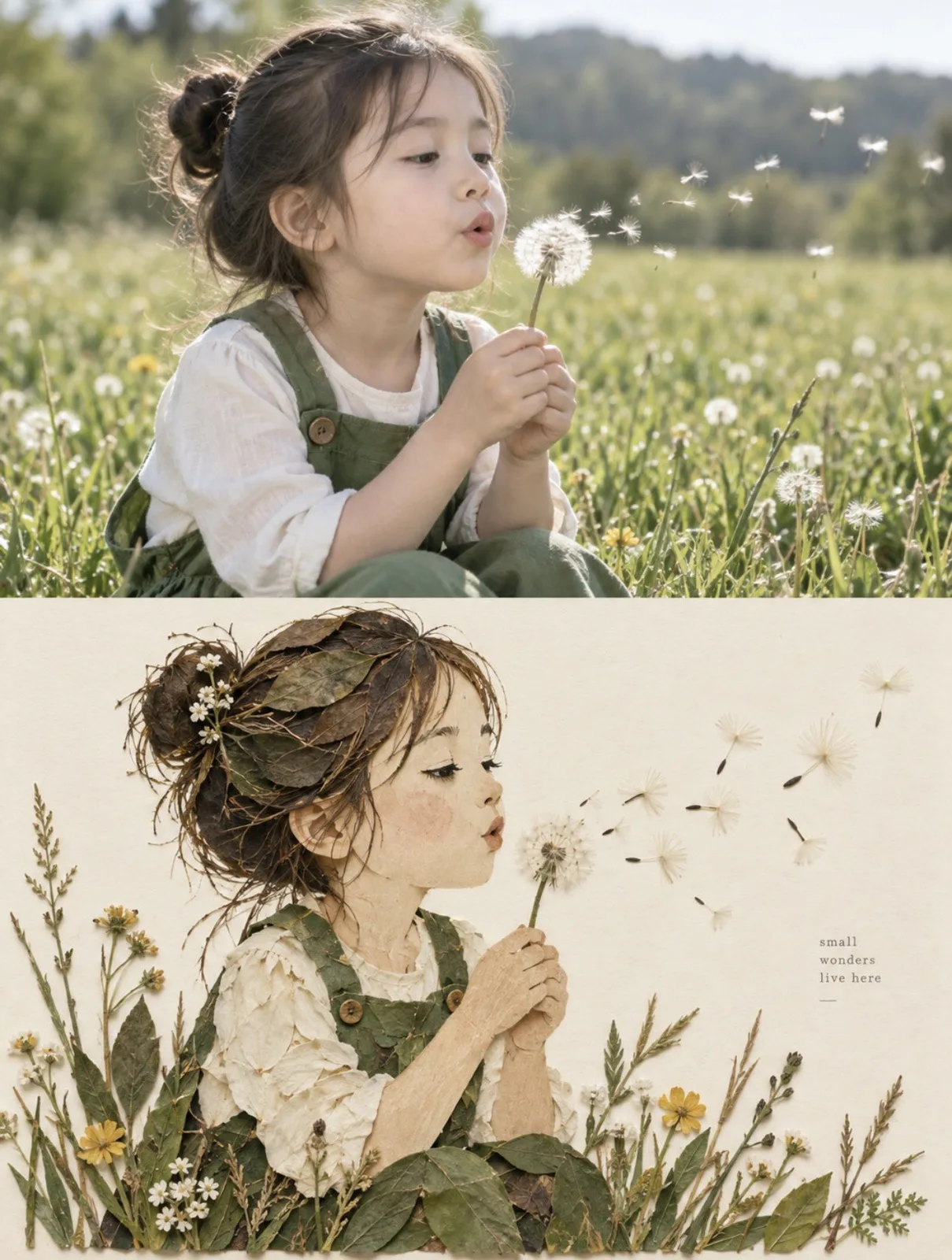
ChatGPT
İllüstrasyonChatGPT
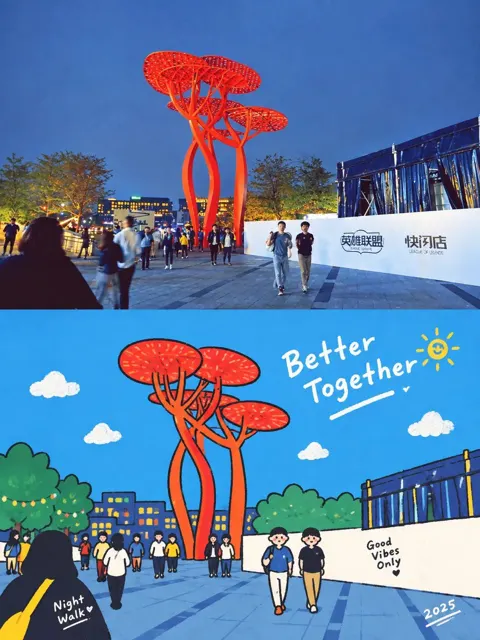
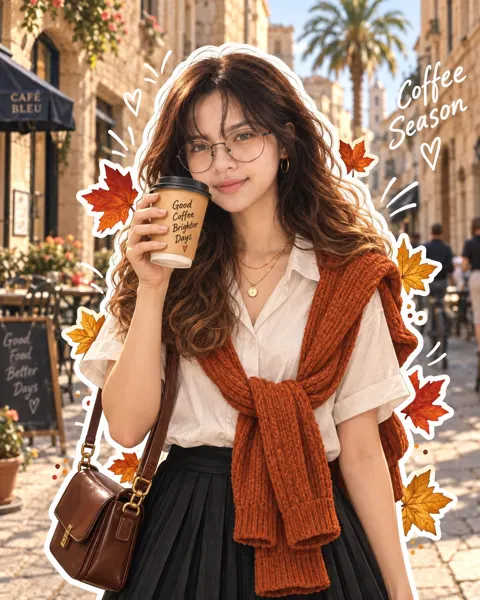
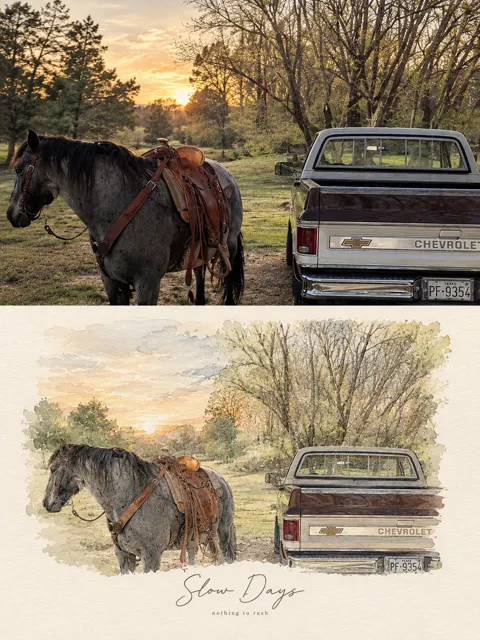
Real photo to natural material collage illustration
Üretici @zhidawang219555
Prompt
Create a vertical split-screen visual work. The upper part is a real photo uploaded by the user, and the lower part re-translates the figures, pets, animals, or subject relationships from the upper photo into an editorial illustration composed of real natural materials.

The upper and lower images must maintain a clear correspondence in subject identity, outline, posture, and relationship.

Upper Part | User-uploaded original photo
Keep the real photo in the upper part.
Prioritize identifying people, pets, animals, human-animal combinations, and multi-person relationships.
Completely maintain the subject's original identity characteristics, including facial shape, hairstyle, clothing, posture, and movements for people; fur color, patterns, ears, facial shape, body proportions, tail, and movements for pets or animals.
Do not transform the upper part into leaves, petals, or illustrations beforehand.
Allow reasonable cropping according to the vertical layout, but keep the core subject complete and recognizable.
Buildings and complex environments are only kept as the photographic background of the upper part; the lower part does not use buildings as the main translation object.

Lower Part | Natural material collage editorial illustration translation
Extract the most recognizable subject, outline, posture, and narrative relationship from the upper photo, and reconstruct it into an editorial illustration composed of real natural materials.
Use clearly identifiable leaves, petals, branches, fruits, seeds, grass stems, bark, or dry leaves, directly utilizing their original shapes, textures, color differences, and irregular edges to assemble the subject.
Do not cut the plants into overly precise geometric shapes, nor use a complete illustration outline to enclose the plants.
Make the viewer recognize that the bottom represents the same person, animal, or group of interacting subjects as the top photo, while also clearly seeing that it is ingeniously composed of real natural elements.
Natural materials are not decorations outside the person's photo, but truly undertake the subject's body structure.
For example:
A person's hair can be formed by naturally curling or layered leaves, grass stems, or petals;
Clothing can utilize leaves of different sizes and comprehensive color differences to form the main area;
Arms and legs can be represented using branches, grass stems, or elongated leaves according to the original posture;
Pet ears can choose naturally pointed leaves;
Tails can use curved branches or slender plant materials;
Face and body should try to utilize the natural materials' own outlines rather than relying on extensive drawing.

The composition establishes order with a simple rectangular color field or paper area, but do not deliberately draw a complete border.
The subject maintains a natural internal and external relationship with the rectangle, with most of it falling within the color field and a few most directional parts naturally extending beyond the boundary.
A person's extended hand, a pet's tail, ears, branches, or movement directions can naturally exceed the color field, giving the image a relaxed sense of "crossing boundaries"; like plants just happening to grow out of the layout, rather than striking a pose for the sake of "breaking the frame."
Maintain a large amount of white space, a clear center of gravity, and incomplete symmetry, allowing the randomness of natural materials to coexist with the order of editorial design.

Black lines appear only as a minimal auxiliary language and do not serve as the overall outline for the subject.
Can be used for eyes, mouths, minimalist expressions, small movement hints, local connections, short lines, handwriting marks, or slight visual rhythms in the layout.
The lines are thin, relaxed, and slightly hand-drawn, letting the plants themselves undertake the subject's form and outline.
In particular, it is forbidden to use black lines to completely outline a person's body or a pet's outer contour and then fill it with plants.

The color scheme extracts the most vital and recognizable color temperament from the original image in the upper part, and then re-translates it through the colors of natural plants themselves.
For example, if the person above wears green, orange, or blue clothing, the bottom can look for real materials like leaves, petals, or fruits with similar comprehensive colors for correspondence.
A pet's orange, gray, black and white patterns, etc., can also be cleverly reproduced using the comprehensive color differences of natural materials, but the plants cannot be artificially dyed into completely uniform color blocks to match the colors.
Retain the real comprehensive color differences of leaves, petals, fruits, and dead branches, without excessive uniform dyeing.
The background uses light or soft comprehensive colors coordinated with the original image, making the natural materials the visual center of the image, overall fresh, restrained, vital, and not cluttered.

Text remains minimal and acts as a lightweight element in the editorial design.
Extract a short English title and a few micro-annotations from the photo's mood, action, relationship, or metaphor, which can be placed close to the edge of the rectangular color field, suspended in the white space, or cleverly aligned with a branch or leaf direction.
Don't overshadow the subject, and don't make it like a regular poster title.
If the photo's emotion is very clear, the text can express its hidden relationship; if not necessary, text can be further reduced.

The overall presentation is a visual relationship of real natural materials x slight black hand-drawn marks x geometric color field x natural boundary crossing, maintaining a sense of handmade, clever, relaxed, poetic, and high-end editorial feel.
The bottom is not an ordinary "leaf portrait sticker," but should be as if an art director carefully selected different natural materials to cleverly reconstruct the person or pet from the upper photo with natural outlines.
Avoid complete black outlines, plants cut into regular color blocks, children's leaf collages, deliberate boundary crossing, cartoon collages, and templated compositions.
Forbidden to recreate people or animals unrelated to the identity above.
Forbidden for complex buildings to become the main objects of natural material collage.
Metni kopyala, kendi detaylarını ekle ve kullandığın görsel modelinde dene.