Piko
Piko Promptu incele ↗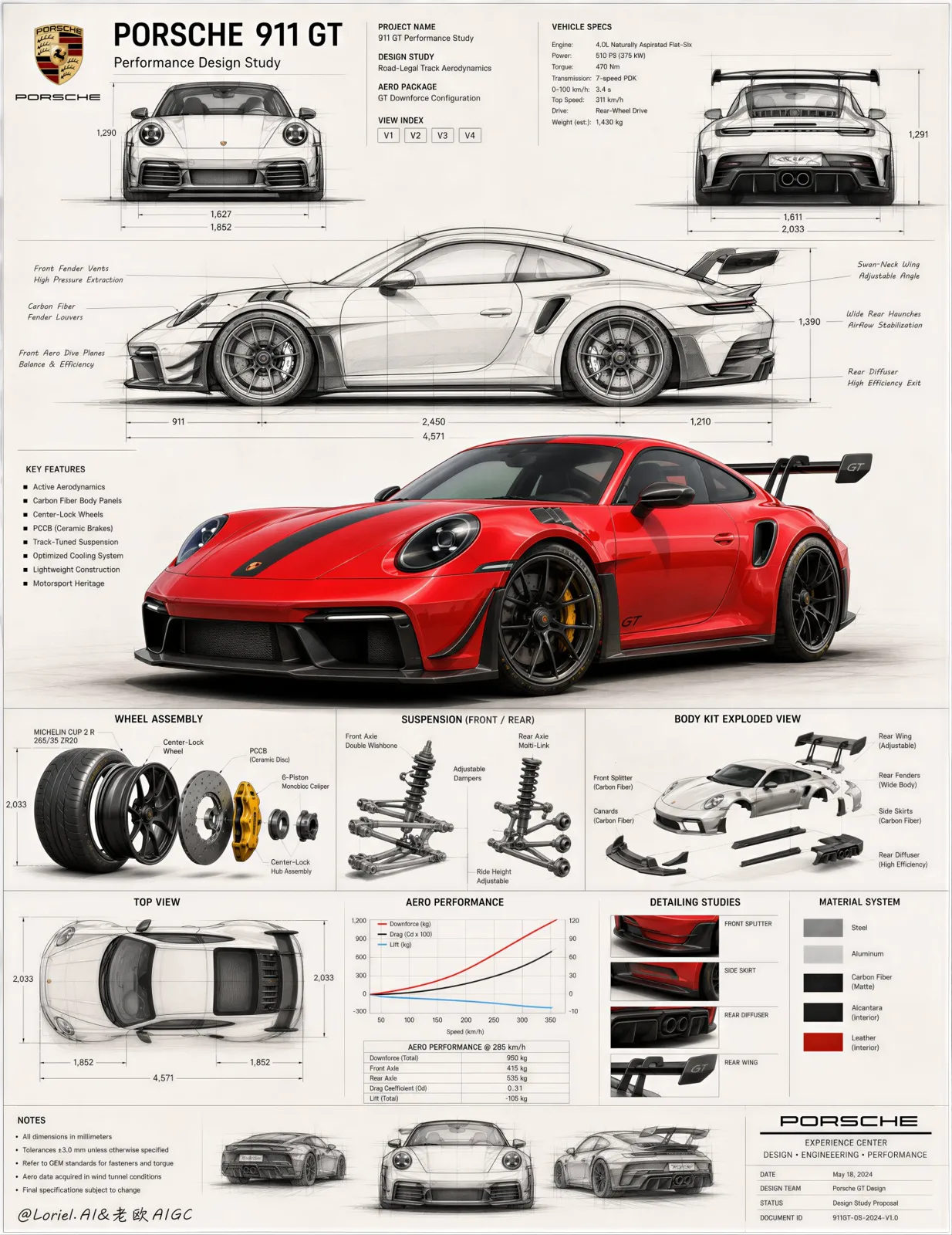
Grok
FotoğrafGrok
Porsche 911 gt premium automotive design board
Üretici @ou_zhen599
Prompt
Create a world-class premium automotive design presentation board for the Porsche 911 GT, designed as an official high-end technical concept sheet that merges Orbit-level product realism, Transit-level OEM system standardization, and Port-level proposal-board completeness. The image must fully preserve the exact structural logic of a luxury multi-view vehicle blueprint poster: a large central side-profile technical drawing, front and rear elevation views across the top, one ultra-realistic hero render of the car dominating the middle-lower area, multiple engineering component panels across the lower section, a top-view blueprint, detailed aero-part studies, a compact aerodynamic performance chart, and refined official-style labeling throughout the page. The final artwork must feel like a formal Porsche performance design proposal board, combining real product realism, hand-drawn sketch-overlay precision, and highly disciplined engineering layout.

Core composition:
Use a tall vertical poster on a clean warm white or soft technical-paper background. Organize the board into clearly separated horizontal bands:
1. top band: main title block, project metadata, front view, rear view
2. upper-middle band: large side-profile engineering drawing with dimensions and callouts
3. center band: ultra-realistic front three-quarter hero render
4. lower-middle band: wheel assembly, suspension system, body-kit exploded view
5. lower band: top-view blueprint, aero performance chart, detailing studies, materials / notes / official brand block
The whole page must feel precise, premium, technical, and visually balanced, like an OEM release or advanced internal design proposal.

Vehicle subject:
The subject is Porsche 911 GT, shown as a real high-performance 911 GT design study with unmistakable Porsche identity and factory-authentic surfacing. Preserve:
- classic 911 roofline and greenhouse
- round Porsche headlamp signature
- low front overhang
- wide rear haunches
- aggressive front aero detailing
- center-lock wheel system
- large motorsport rear wing or swan-neck rear wing
- deep rear diffuser
- sculpted lower side aero channels
- true Porsche body proportions and shut-line discipline
The car must feel like a believable advanced 911 GT road-and-track variant, not an aftermarket fantasy build.

Orbit-level realism:
Push the realism of the car much further. Emphasize:
- front splitter edge precision
- front fender vent / louver detail
- rear wing supports
- rear diffuser geometry
- center-lock wheel hardware
- carbon-fiber aero texture
- ceramic brake detail
- tire sidewall lettering and tread realism
- exact Porsche lamp internals
- subtle paint micro-reflection, dust trace, and shadow grounding
The vehicle must feel surgically real, factory-authentic, and de-AI.

Hero render:
Place one large ultra-realistic front three-quarter hero render in the center-lower area. Use a premium body color such as Guards Red with black motorsport striping and exposed carbon-fiber aero components. Show master-level realism in paint depth, clearcoat reflections, windshield distortion, carbon weave, wheel finish, brake hardware, headlamp internals, panel transitions, and grounded contact shadow. The hero car must dominate the board visually.

Top orthographic views:
Across the upper area, place:
- front elevation
- rear elevation
Both views must be technical, clean, dimensioned, and lightly overlaid with hand-drawn engineering sketch lines. Keep the linework elegant and measured, like a real performance-car design board.

Side-profile engineering drawing:
Create one large side view of the Porsche 911 GT in the upper-middle area, drawn as a refined technical sketch with exact wheelbase, overhangs, roofline, wing geometry, and aero surfaces. Add measurement lines and dimensional markers. Blend blueprint precision with hand-rendered sketch energy:
- layered contour strokes
- correction lines
- construction ellipses
- gray marker shading
- subtle paper grain
This sketch-to-engineering fusion is essential.

Hand-drawn technical language:
Strengthen the industrial-design hand-sketch feel across the full board:
- layered contour refinements
- construction guides
- soft gray marker washes
- sectional emphasis lines
- engineering arrows
- surfacing notes
- perspective correction traces
- tonal overlays around wheel arches, aero surfaces, and wing forms
The page must feel like a premium design-office hand-developed technical proposal, not a sterile CAD screenshot.

Transit-level OEM system:
Standardize the full board into a mature OEM-style field hierarchy. Use consistent section labels and micro-headings such as:
PROJECT NAME
DESIGN STUDY
VEHICLE SPECS
KEY FEATURES
WHEEL ASSEMBLY
SUSPENSION
BODY KIT EXPLODED VIEW
TOP VIEW
AERO PERFORMANCE
DETAILING
MATERIAL SYSTEM
NOTES
VIEW INDEX
All headings, captions, labels, spacing, dividers, and line weights must feel completely standardized and globally premium.

Accurate key figures:
Use clean, restrained, internally consistent Porsche 911 GT performance data in OEM style:
Engine: 4.0L naturally aspirated flat-six
Power: 510 PS
Torque: 470 Nm
Transmission: 7-speed PDK
0–100 km/h: 3.4 s
Top Speed: 311 km/h
Present all figures with elegant spacing and subtle separator rules, never cluttered or brochure-like.

Lower engineering panels:
Create three premium lower-middle modules:
1. Wheel Assembly:
exploded wheel, tire, brake disc, caliper, hub assembly
2. Suspension:
isolated damper / linkage / spring technical study
3. Body Kit Exploded View:
front splitter, canards, side skirts, rear fenders, rear wing, diffuser
These panels must feel realistic, mechanical, technical, and beautifully organized.

Top view and aero analysis:
In the lower section, add:
- one top-view blueprint with dimensions
- one compact aerodynamic performance chart showing drag / downforce / speed logic
- a detailing strip with small studies of splitter, side skirt, diffuser, rear wing
All graphics must be thin, elegant, and clearly OEM-inspired.

Port-level proposal completeness:
Elevate the board into a formal official design-release sheet. Add restrained metadata such as:
Project Name: 911 GT Performance Study
Design Study: Road-Legal Track Aerodynamics
Material System: Steel / Aluminum / Carbon Fiber / Alcantara
Aero Package: GT Downforce Configuration
View Index: V1 / V2 / V3 / V4
Notes: Dimension references in millimeters
These fields must be integrated beautifully so the page feels like a true official Porsche proposal board.

Brand presentation:
Use only English text. Create a refined main title such as:
PORSCHE 911 GT
Performance Design Study
Add a minimal Porsche crest and Porsche wordmark in a restrained official position. Typography must feel thin, modern, precise, and globally premium.

Lighting and rendering:
Use clean studio-technical lighting with soft premium shadows and controlled reflections. The hero render must be crisp, bright, and premium, while the smaller panels remain slightly flatter and more document-like. The full page should feel like a luxury engineering presentation.

Color direction:
Use a restrained palette of warm white technical paper, graphite gray linework, black typography, Guards Red hero body color, carbon black, brushed metal gray, and subtle technical beige accents. Keep the whole page cohesive, elegant, and official.

Commercial goal:
The final artwork must feel like an award-level Porsche 911 GT technical presentation board: highly realistic, multi-image driven, hand-sketched yet engineering-accurate, OEM-disciplined, and visually unforgettable. Preserve the exact multi-view specification-board logic while elevating it into a more premium, more standardized, and more complete official GT design release visual.

Negative prompt:
generic sports car, incorrect Porsche proportions, fake 911 roofline, wrong wheels, inaccurate rear wing, messy blueprint layout, cheap brochure style, cartoon rendering, cyberpunk clutter, plastic materials, low-resolution linework, overcomplicated text, distorted perspective, fake exploded view, inaccurate engineering components, noisy layout
Metni kopyala, kendi detaylarını ekle ve kullandığın görsel modelinde dene.