Piko
Piko Promptu incele ↗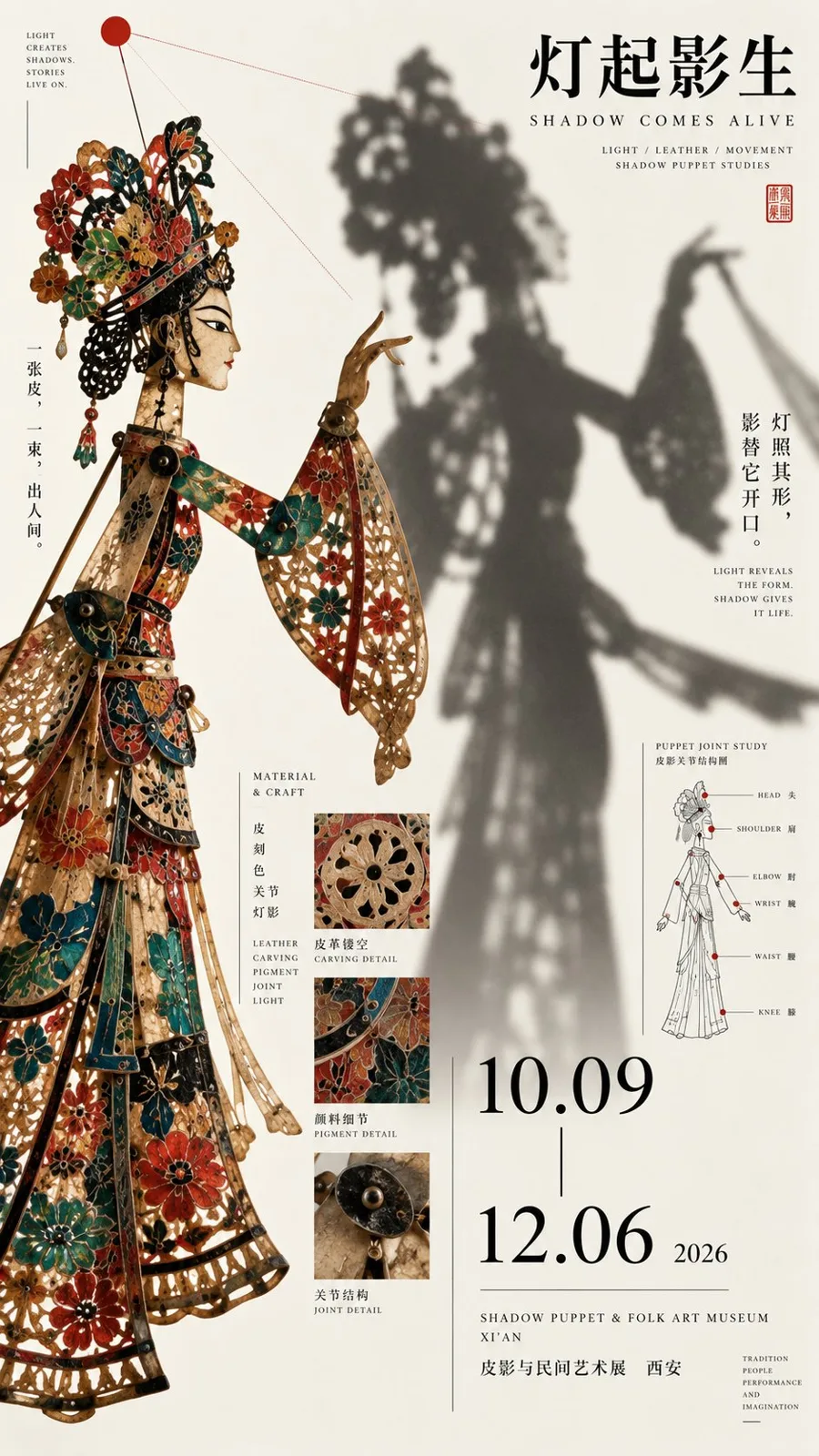
ChatGPT
TasarımChatGPT
Oriental culture exhibition poster asymmetric composition
Üretici @MrLarus
Prompt
[Theme]:
[Chinese Title]:
[English Title]:
[Left Core Content]:
[Right Core Content]:
[Left-Right Relationship]: Entity × Projection / Subject × Text / Raw Material × Result / Chiaroscuro / Dense × White Space / Other
[Cross-border Elements]: Subject Outline / Shadow / Lines / Texture / Title / Other
[Main Color Tone]:
[Secondary Color]:
[Date / Venue]:
[Aspect Ratio]: 9:16

Generate a high-aesthetic, high-information density Oriental culture exhibition poster, using "left-right composition / asymmetric dual-zone composition."

The left and right should not be split evenly 50/50, but establish a clear visual hierarchy based on the theme, such as 40/60, 45/55, 35/65. Both sides undertake different tasks, achieving balance through visual weight rather than equal area.

The left-right relationship can be flexibly selected according to the theme:

Entity × Projection: Place real people or artifacts on one side, and place shadows, light, movement trajectories, or other visual results generated by them on the other side, creating a causal relationship between left and right.

Subject × Text: Use a large subject to anchor the frame on one side, and use large titles, small text, dates, archive information, and research diagrams to establish reading weight on the other side.

Raw Material × Result: One side shows the original state of ore, woodblock, material, or craft, while the other side shows pigments, imprints, finished products, or application results, letting the composition itself explain the process of change.

Dense × White Space: Use artifacts, archive fragments, patterns, and research information to establish a high-density visual on one side, and maintain larger white space on the other side, placing only a title or a small number of strong graphics, creating a sense of design through the contrast between dense and sparse.

Chiaroscuro: Allow one side to use bright paper surfaces like bone white or light gray, and the other side to use strong color gamuts like ink black, deep red, or deep cyan, forming a clear visual collision.

The left and right cannot be completely fragmented. Let subjects, shadows, branches, text, brushstrokes, patterns, or fine lines appropriately cross the midline to reconnect both sides as a whole. Boundaries can be broken, but do not turn it into a messy collage.

Typography is redesigned according to each image, using full horizontal titles, staggered large characters, medium titles, cross-border text, or partial color inversion. Do not fixedly use four-character vertical arrangements, and do not repeat the "two-character horizontal + two-character vertical" template.

Information density refers to mature museum posters, Japanese Editorial Design, and art catalogs. Can add English subtitles, materials, techniques, dates, venues, curatorial short sentences, and a small amount of research content related to the theme, such as structural line drawings, partial macros, material sections, production processes, or pattern research.

Research content only serves as the second layer of reading information, concentrated in 2–3 areas, do not make it into a PPT, encyclopedia page, or regular information card.

Color is controlled within 3–5 main colors, establishing a memory point with one clear main color, and then matching with basic colors such as black, bone white, and dark gray. Keep color blocks clean, materials real, and contrast clear.

The first sight sees the strongest subject and the left-right visual contrast; the second sight reads the title; the third sight discovers the cross-border or causal relationship between the two sides; finally read the material, structure, craft, and exhibition information.

Core Principle: Left and right do not need to be equal, visual weight needs to be balanced. One side is responsible for catching the eye, the other side is responsible for carrying the reading. Establish the boundary first, then actively break it.

Overall Requirements: High-definition, clear, clean paper surface, sharp subject, hierarchical Typography, small characters and fine lines as clear as possible, information-rich but orderly, with the completion level of mature cultural exhibition posters and art publications.
Metni kopyala, kendi detaylarını ekle ve kullandığın görsel modelinde dene.