Piko
Piko Promptu incele ↗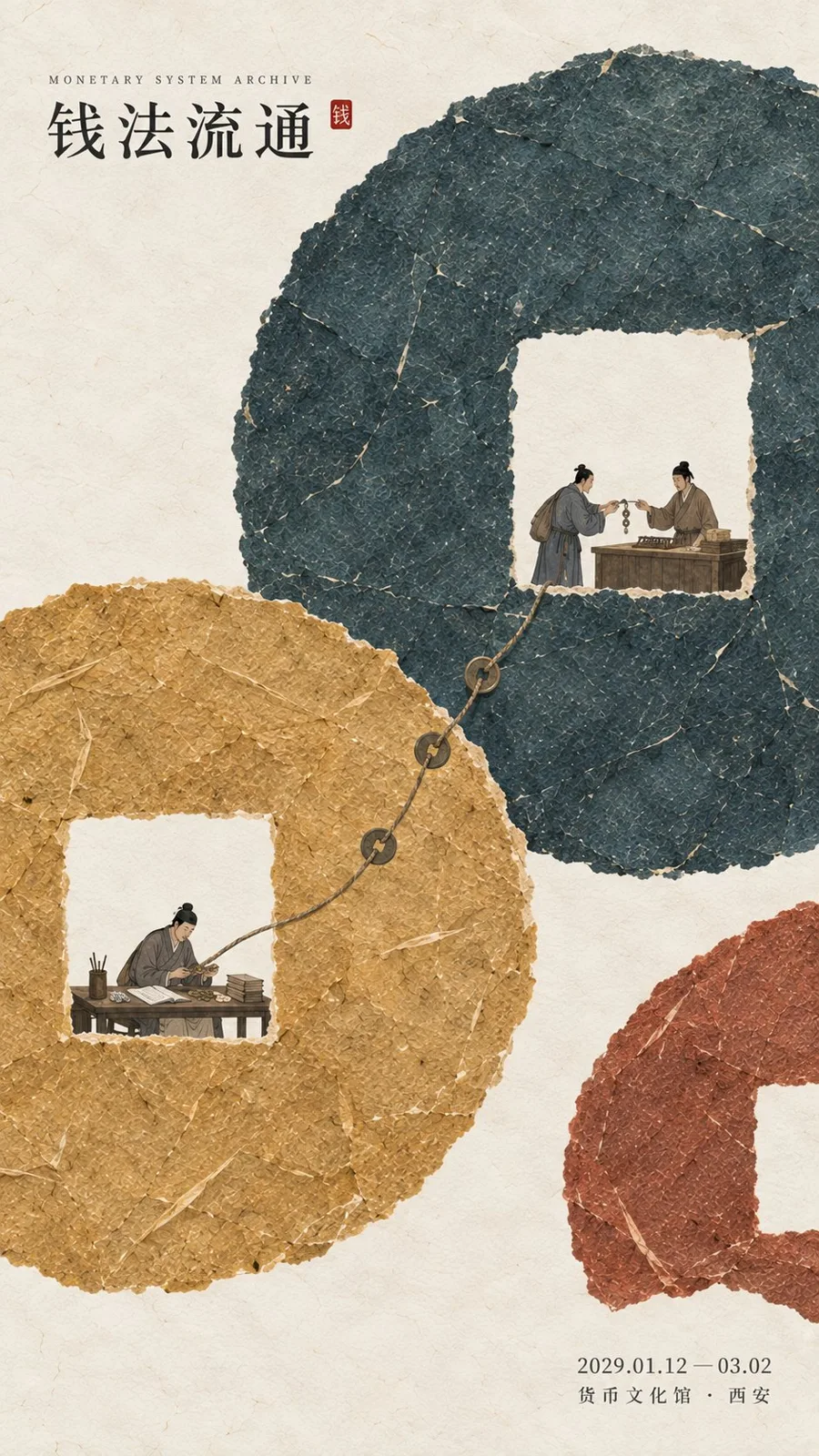
ChatGPT
TasarımChatGPT
Modern oriental aesthetic paper fiber exhibition poster
Üretici @MrLarus
Prompt
[Subject / Exhibition Name] {Fill in, e.g., Currency System / Phenology and Calendar / Temperament Standards / Land Surveying}
[Main Title] {Fill in}
[Core Abstract Concept] {Fill in, e.g., Circulation / Cycle / Calibration / Division}
[Main Color Gamut] {Fill in 3–5 colors, e.g., Deep Ink Blue + Earth Golden Yellow + Cinnabar Ocher / Spring Green + Summer Cyan + Autumn Ocher + Winter Blue}
[Main Visual Structure] {Fill in, e.g., Square-hole Circular Ring / Open Spiral / Long and Short Paper Pillars / Irregular Field Block Patchwork}
[Micro-narrative] {Fill in 2–4 real behaviors, e.g., Exchange and Bookkeeping / Observation and Recording / Pronunciation and Calibration / Surveying and Recording}
[Exhibition Information] {Date / Venue, optional}
[Aspect Ratio] 9:16 vertical version

Design a historical and cultural exhibition poster with modern Eastern editorial aesthetics, using "paper fiber + large color gamut + micro scenarios" as the core visual language. Do not start from ordinary ancient style scenes, but first refine the [Core Abstract Concept], and then use the [Main Visual Structure] to directly transform this concept into a large-area paper-based composition. For example, express circulation through a square-hole structure, express cycles through continuous rotation relationships, express standards through long and short scales, and express division through color block stitching and boundary relationships, so that viewers can feel the logic behind the theme from the composition even without reading the text.

Use the [Main Color Gamut] to establish 3–6 large paper color blocks with clear visual weight. All color blocks maintain a real and rich texture of handmade paper, watercolor pulp, mineral or plant pigments, with visible natural long and short fibers, pulp particles, pigment deposits, large-scale natural shading, slight indentations, and irregular torn paper edges; the color surfaces are complete, matte, clean, and have a sense of material, without dirt, yellow spots, strong noise, cheap vintage, or digital gradients. The large color gamut must bear the primary vision, remaining clearly identifiable in terms of main formal relationships even after being reduced to social media feed sizes.

Rotate, intersperse, stitch, vary scales, complement, enclose, partition, or create continuous relationships between the large color gamuts according to the theme, instead of simply laying a few color blocks on the background. The composition should have a very clear sense of method, allowing people to understand the large shape at first glance and produce a visual surprise of "this relationship is very interesting" at the second glance. Appropriately reserve warm ivory white negative space as a breathing area, but do not leave large areas empty just for minimalism; negative space must participate in the structure.

Embed [Micro-narrative] into the large paper color gamut, with characters and objects accounting for approximately 3%–6% of the screen. Characters must be performing real actions directly related to the theme, such as exchanging, recording, observing, calibrating, surveying, boundary setting, etc., rather than standing and posing. Micro-scenes can be distributed at different color gamut nodes, but do not make them into four-grid layouts, flowcharts, or step cards; they should be like small stories hidden in the huge color gamut, so that viewers only discover the complete human behavior and institutional logic behind the abstract structure when they get close.

Character clothing, objects, and environment remain restrained, keeping only the necessary elements to help understand the theme. Do not randomly stack ancient architecture, auspicious clouds, birds, flowers and birds, seals, brush calligraphy, or traditional patterns for the sake of an "Eastern cultural feel." A very small amount of cinnabar red, warm orange, or old gold can be used as institutional nodes, recording marks, or visual focal points, but they must have a real relationship with the content, with the total area controlled at 1%–3%.

Text typography adopts the Eastern editorial language of modern museums, historical archive exhibitions, and knowledge system exhibitions. The main title [Main Title] uses slender, upright Chinese Songti, Mingti, or modern fonts with a sense of publishing, maintaining small to medium font sizes so that Typography does not overwhelm the large color gamut. English sub-headings, dates, and venue information use smaller font sizes. The entire poster should try to retain only three sets of core text: "English sub-heading + Chinese main title + date/venue," without adding long subtitles, poems, sidebar descriptions, or meaningless English placeholders.

The overall reading order should be: large color gamut and abstract structural relationship → core concept → micro characters and real behavior → title and exhibition information. The final image should achieve a strong memory point of large shapes, colors, and composition from a distance, while paper fibers, character movements, cultural details, and knowledge logic appear only when viewed up close, combining material texture, design sense, and narrative sense.Metni kopyala, kendi detaylarını ekle ve kullandığın görsel modelinde dene.