Piko
Piko Promptu incele ↗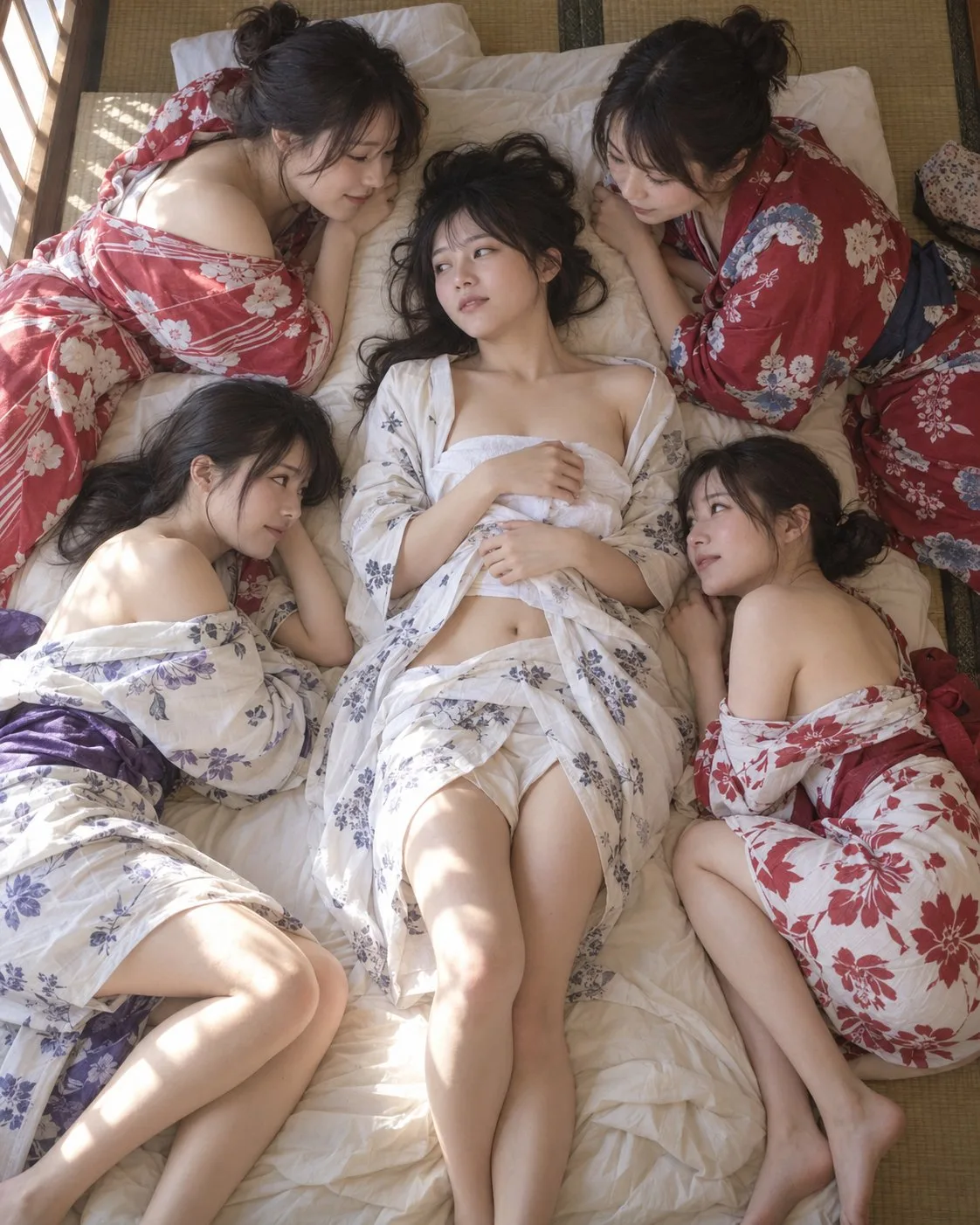
ChatGPT
FotoğrafChatGPT
Afternoon on tatami yukata girls
Üretici @Live_life_style
Prompt
{
  "Direction": "This is a top-down portrait taken in natural light, capturing a fleeting afternoon moment in a room of an old-fashioned Japanese ryokan or minshuku. In the photo, five fictional adult women in their early to late twenties are resting on tatami mats. The focus is not on their faces, but on the radial arrangement of the figures, with one person in the center and four surrounding her. They are dressed in yukatas (summer kimonos) primarily in red and white, on tatami and off-white futons, with natural light slanting in from the left, like sunlight dappling through treetops. This is not a posed group photo of women lined up, but a realistic photograph, as if taken casually from a height by a companion during a summer trip, documenting a scene of five women chatting or resting in a room. The people in the photo are not any specific celebrities, influencers, or real people.",
  "Atmosphere": "A quiet ryokan on a summer afternoon. After lunch and bathing, two close friends returned to the room, wearing yukatas and relaxing on the tatami. They look a bit sleepy and slightly lazy, as if their previous conversation has temporarily paused. This is not a glamorous advertising photo, but a daily moment of a trip that only friends can see. Gentle and slightly nostalgic, lazy and cozy, but without any hint of eroticism or provocation.",
  "Models": "Five adult women. They are clearly adults in their early twenties to late thirties. They are fictional East Asian women, but not referring to any specific person. These five women have natural individual differences in facial features, contours, hairstyles, height, shoulder width, and body type; they are not designed to be identical clones. The central figure is the visual protagonist, but the four around her also have a strong presence.",
  "Face": "Natural adult female features. Light daily makeup, natural eyebrows, delicate eye makeup, and not-too-intense lip color. Faces are slightly asymmetrical, with a faint blush on the cheeks, slightly tired eyes, and slightly relaxed corners of the mouth. Not everyone is showing a perfect smile; the gaze of the central figure in the image is slightly turned to one side. The surrounding figures are not looking directly at the camera, but at the central figure or each other's expressions.",
  "Hair": "The hair color of the five models is mainly black to dark brown, and the length naturally varies, ranging from long hair to medium-length hair to shoulder-length hair. Due to gravity, the hair of the reclining people fans out on the tatami or futon, with some strands falling on the cheeks, forehead, and ears. There is no shortage of strands sticking together due to sweat or moisture, messy bangs, and hair that is slightly messy due to friction with pillows. Such hairstyles do not pursue the flawless effect found in advertisements.",
  "Body": "Showing the realistic body proportions of adult women. The five figures differ slightly in height, body type, leg length, and shoulder width. The central figure lies on her back, with the vertical lines of her body running through the center of the frame. The four surrounding figures are in various poses, some lying on their sides, some slightly bent, and some curled up, forming a frame where straight lines and curves intersect. Shoulders, collarbones, arms, parts of the abdomen, and legs visible through clothing are all naturally displayed due to the person's posture and the placement of the yukata (kimono), and the composition does not emphasize any specific body part.",
  "Skin": "Realistic skin texture. Retaining faint pores, subtle uneven skin tone, slight redness, and natural shadows. Areas directly exposed to light are slightly brighter, while areas in the shadows of shoji doors or grilles are slightly darker. The skin tone and lighting of the five figures are not completely identical. At fabric contact points, very subtle indentations and natural color differences similar to temperature differences are left. Avoid excessive whitening, porcelain-like smoothness, and uniform retouching of the entire body.",
  "Clothing": "All five are wearing summer yukatas, with the main colors being red, white, navy blue, and off-white, but the patterns and ways of wearing them are different. Due to lying down or curling up, their necklines, shoulders, sleeves, and hems naturally vary slightly. These yukatas do not look meticulously arranged, but rather seem to be casually scattered after staying in a ryokan (traditional Japanese inn) for several hours.",
  "outfit_center": "The central figure in the frame is wearing a white to off-white yukata with a white lining. The person is lying on her back with a loose collar, and the skin around the shoulders, collarbones, and abdomen forms a relatively large bright area in the center of the frame. The chest is naturally covered by white fabric and arms, and some yukata fabric remains around the waist. The skin tone and white fabric extend upward, forming a visual pillar in the center of the frame.",
  "outfit_upper_left": "The person in the upper left corner is wearing a yukata mainly in red and white. She is lying on her side, her body leaning towards the head of the central person, with the collar and one shoulder clearly open, naturally revealing the shoulder, collarbone, and part of the arm. The chest is covered by overlapping white lining and yukata. The red and white fabric forms a striking diagonal line from the upper left corner towards the center.",
  "outfit_upper_right": "The person in the upper right corner is wearing a predominantly red yukata with Japanese patterns in white, navy blue, and light blue. Of the five photos, this yukata has the most fabric and reveals relatively little skin. Large areas of red fabric are exposed, making it the main color accent of the entire photo.",
  "outfit_lower_left": "The person in the lower left corner is wearing a predominantly white yukata decorated with navy blue and purple patterns, and tied with an obi. She is lying on her side, with loose shoulders and sleeves, and the hem moves with her posture. In the foreground of the frame, her thighs occupy most of the space in the lower left corner of the screen, where the white yukata, skin, and purple accents complement each other. The leg itself is not the subject of the frame, but is used to compose the foreground.",
  "outfit_lower_right": "The person in the lower right corner is wearing a white yukata with red Japanese patterns. Because she is curled up with her knees bent and one shoulder slumped, her shoulders, arms, and part of her bent legs look natural and fluid. The hem, knees, and shoulders of the yukata form a rounded silhouette, contrasting with the straight body of the central person.",
  "Accessories": "Accessories are very minimalist. Only small earrings, thin hair ties, and simple hair clips. No luxury jewelry, large hair accessories for photography, or excessive Japanese accessories are used.",
  "Scene items": "Tatami, white or off-white Japanese mattresses, slightly wrinkled sheets, thin quilts, wooden shoji doors or lattice doors. The mattress is naturally depressed and covered with wrinkles due to the weight of the five people, and the edges of the sheets are not perfectly aligned. Tatami edges, fabric folds, and small strips of cloth or towel fragments can be placed at the edges of the shoji doors. Small objects should not be too cluttered to maintain the atmosphere of a typical inn.",
  "Pose": "The central figure C lies on her back, head up, body almost parallel to the vertical axis of the screen, legs relaxed and slightly apart, face slightly turned to the left. Arms naturally place white fabric over the chest. Figure A in the upper left enters from a position near the head of the central figure, her body extending diagonally from the upper left towards the center. She brings her head close to the central figure and slightly raises her upper body. Figure B in the upper right is sitting, either sideways or with knees slightly bent, upper body leaning towards the center. Figure D in the lower left is lying on her side, head slightly tilted to the left side of the screen, waist and legs extending downwards, the leg closer to the audience forming the foreground. Figure E in the lower right is slightly curled up, knees bent, shoulders and back towards the center, face turned towards the center. The five heads form a loose pentagon, but it is not perfectly symmetrical.",
  "Gaze": "Not everyone is looking at the camera. The figure in the center of the frame slightly turns her gaze to the left. The gazes of the four people in the upper left, upper right, lower left, and lower right are naturally drawn to the central figure's face, hands, or near the center of the frame. This creates a structure where the line of sight from the four corners of the photo eventually returns to the center. Avoid the common situation in group photos where everyone looks at the camera at the same time.",
  "Gravity": "Yukatas, hair, sleeves, obis, and bedding all sway with the person's posture and gravity. When lying on the side, the neckline and sleeves of the top will be slightly away from the body, and the fabric of the hem will be squeezed between the body and the bedding, creating wrinkles. When lying on the back, the hair will spread to both sides, and the yukata fabric will hang down to the center of the body, surrounding the waist. When bending the knees, the hem of the yukata will roll up along the shape of the knees. This is not just a depiction of 'messy clothes', but a description of how each piece of fabric moves with the posture, allowing people to intuitively understand the laws of its movement.",
  "Lighting": "The primary light source is natural light coming through the shoji door or window on the left in the afternoon. The color temperature is neutral daylight, approximately 4500-5200K, not the intense orange of sunset. The light is blocked by the grilles of the shoji door, the window frame, and the branches and leaves outside the window, forming thin strips and irregular patterns like sunlight passing through the treetops, slanting onto the figures, yukatas, bedding, and tatami. Especially in the lower half of the screen, there are several bright diagonal light bands, and the light is stronger in the area around the figure in the lower left and the legs of the central figure. The upper right is slightly dim.",
  "Lighting behavior": "The facial lighting of the five people is not uniform. Some people have only a beam of light on one side of their cheeks, some have their entire face shrouded in soft shadows, and others have only their shoulders illuminated. Some areas of the white yukatas and sheets are slightly overexposed, and the shadow parts are not completely brightened, resulting in some blurred details. This exposure difference seems to be a mixture of natural light and weak indoor ambient light.",
  "Color": "In the overall color scheme, skin tones account for about 40-45%, white/off-white accounts for about 25-30%, red accounts for about 10-15%, and tatami and wood use beige/brown about 15%. Small amounts of purple, navy blue, and light blue are used as auxiliary accents. The distribution of red on the five people is not uniform, and the red yukata in the upper right is the most intensely colored part.",
  "Effect": "Saturation is slightly below medium. Contrast is soft, sharpness is delicate, and film grain is very weak. There is a small amount of digital noise in the dark parts and light halos in the bright parts. The entire image is not completely retro-processed, but a slight adjustment to modern digital photos to give them a film texture. Skin texture is preserved, and excessive AI-style ultra-high-definition processing is avoided.",
  "Camera": "The camera is located almost directly above the center of the five-person formation. It is estimated that the vertical distance between the camera and the center of the crowd is about 1.5 to 2 meters. The focal length is equivalent to 28 to 35 mm, not an ultra-wide-angle lens. The camera tilt angle is about 0 to 5 degrees. The frame includes the five people and part of the tatami/bedding, where the figures occupy most of the frame. The depth of field is moderate, and the aperture is estimated to be between f/4 and f/5.6, which can clearly present the details of the five people and the tatami/bedding at the same time. At around ISO 400 to 800, there is slight noise in the dark areas. At a shutter speed of about 1/125 second, there is no obvious motion blur, but the hair and fingertips are slightly soft.",
  "Camera feel": "Rather than professional fashion photography, it is more like a natural digital snapshot taken casually during a trip. The top-down composition is carefully designed, but the horizon is not perfectly horizontal; a slight tilt of 1-2 degrees is acceptable. The positions of the figures are also slightly off by a few centimeters. No excessive background blur or cinematic anamorphic effects are used.",
  "Imperfections": "The bedding has subtle wrinkles, indentations caused by body weight, and sagging. Yukata cuffs are asymmetrical, obis are slightly loose, and there are complex folds caused by overlapping fabric. There are a few stray hairs. The tatami color is uneven and has signs of wear. Faces are slightly asymmetrical, and expressions are not perfect. The edges of the frame are not as clear as the center, and slight distortion and chromatic aberration caused by the lens are within the normal range. There is a slight graininess in the dark parts. There is a small amount of overexposure in some areas of the white fabric. Instead of deliberately emphasizing all imperfections, it is better to let them remain within the range that naturally exists in real photos.",
  "Background": "A typical Japanese guest room, located in a slightly old ryokan or minshuku. The tatami is not brand new and has slight fading and wear marks. The shoji doors and wooden frames are very simple, without the complex decorations of luxury ryokans. The walls are off-white or light beige. The interior decoration is not luxurious, and the room gives a warm and comfortable feeling, with soft and pleasant afternoon natural light. There is no marble, LED indirect lighting, designer furniture, or luxurious gold screens.",
  "Mood": "Outside the window is a bright summer day, but the light inside the Japanese room is slightly dim. The dry texture of the tatami, the soft wrinkled yukata, the cotton bedding, and the sunlight spilling through the shoji doors all create a quiet and relaxing atmosphere. We focus more on creating the texture of a real hotel guest room rather than a studio style.",
  "Composition": "Vertical aspect ratio of 4:5 or 2:3. Central figure C is located in the center of the frame, and the lines of head -> shoulder -> torso -> waist -> and legs form the main axis of the photo. A is in the upper left, B is in the upper right, D is in the lower left, and E is in the lower right, arranged radially around central figure C. The positions of the five faces roughly form an irregular pentagon. A's body extends downwards from the upper left corner to the center, forming a diagonal line; B's red yukata serves as an accent in the upper right corner; D's profile and legs form a larger foreground in the lower left corner; E's curled posture adds a splash of color to the curves in the lower right corner. The figures in the four corners are not perfectly symmetrical; their size, angle, and distance vary slightly. The color composition is centered on the vertical plane of the central figure's white and skin tone, surrounded by red and white yukatas.",
  "Framing": "Do not artificially cut off the heads or main limbs of the figures. However, it is acceptable for parts such as yukata hems, bedding, or toes to naturally go outside the frame. Do not place the figures too compactly in the center of the photo; leave enough space around the tatami or bedding. If you want to restore the deep white areas at the top and bottom of the original image, place the photo in the center of a vertical canvas and add wide black or deep charcoal white areas at the top and bottom.",
  "Realism priority": "The order of importance is: 1. Exactly five adult women; 2. Top-down perspective; 3. One person in the center, four people arranged radially around; 4. Vertical body lines of the central figure; 5. Everyone wearing different red and white yukatas, with different ways of wearing them; 6. Japanese room, tatami, and off-white bedding; 7. Natural light slanting in from the left; 8. Gazes of the surrounding four people converging on the center; 9. Asymmetrical poses and natural drape of fabrics; 10. Soft film tones and exposure effects that leave shadows.",
  "Negative": "Four people, six people, changes in number of people, everyone having the same face, twin-like faces, everyone looking at the camera, everyone posing in the same way, perfect symmetry, composition with the central figure sitting, side-shot, strong low angle, fisheye lens, extreme ultra-wide angle distortion, arms and legs merging between people, extra limbs, distorted fingers, yukata patterns extending to others, clothes unnaturally sticking to the body, fabric violating laws of physics, five people with same exposure, perfect clothing, explicit body language, provocative poses, exposing important parts, suspected minors, doll-like faces, plastic-like skin, excessive retouching, excessive HDR, studio lighting that illuminates everyone uniformly, excessive background blur, luxury ryokan, luxury hotel, marble, overly tidy beds, excessive cinematic effects, faces resembling real people or celebrities"
}Metni kopyala, kendi detaylarını ekle ve kullandığın görsel modelinde dene.