Piko
Piko Promptu incele ↗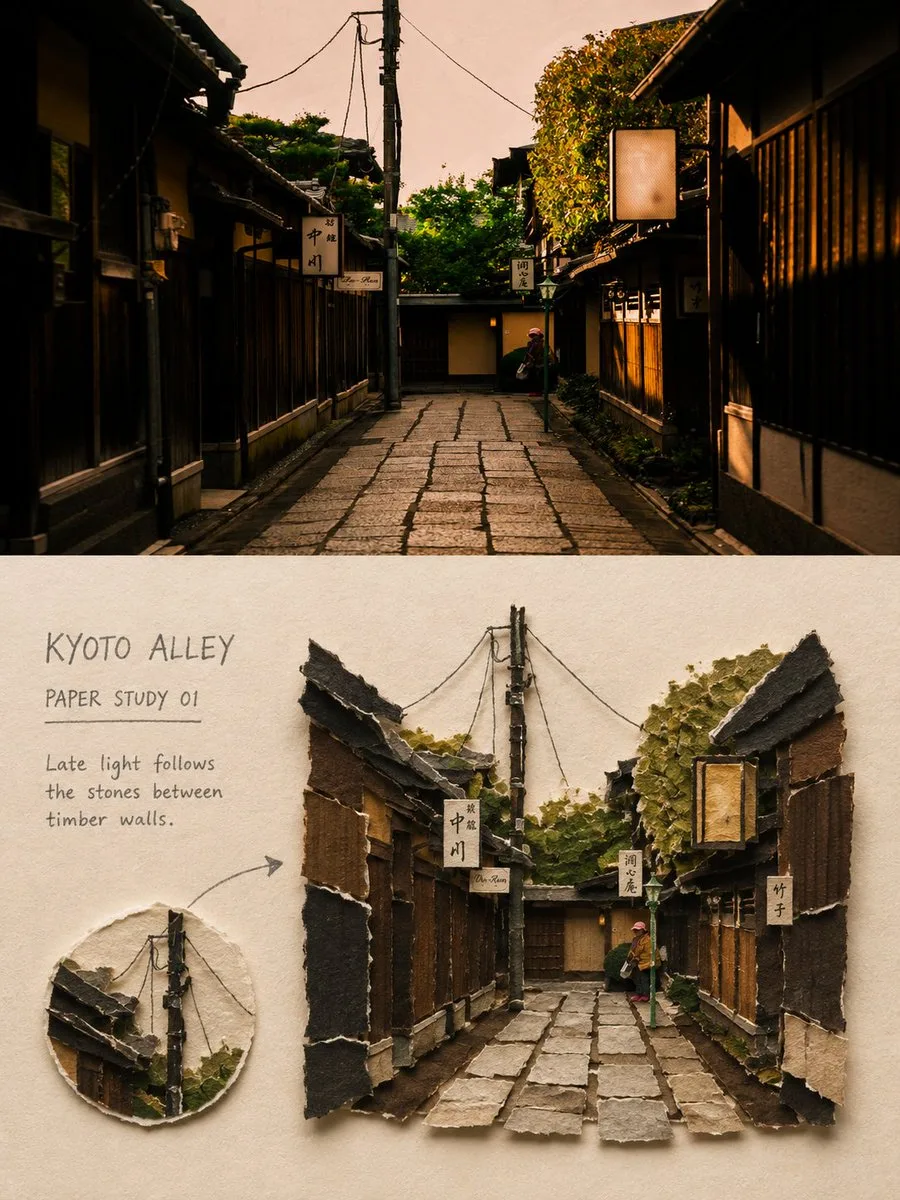
ChatGPT
TasarımChatGPT
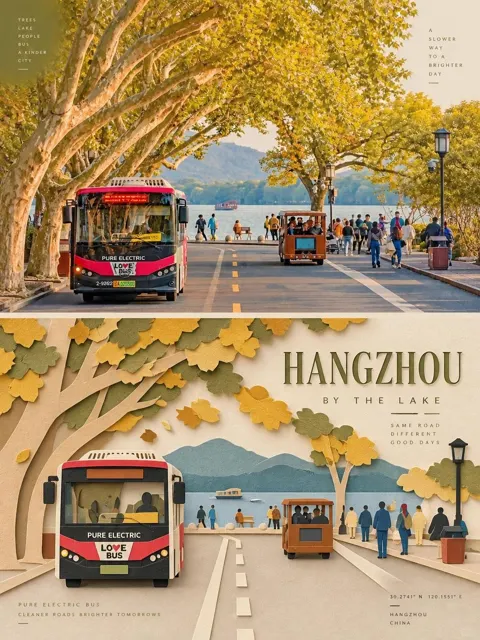
Advanced torn paper art street photography poster
Üretici @Hamburgerai
Prompt
Please turn each of the travel street view photos I upload into an independent advanced torn paper art editorial poster, not a multi-image collage, with each photo output individually. The overall composition adopts a 3:4 vertical dual-panel layout, with the top part retaining a clearly visible authentic original image, and the bottom part reconstructing the same street alley as a "torn paper alley reconstruction"; the height of the top and bottom areas is nearly 1:1, using a clear, horizontal boundary, without blurring or mutual penetration. Only output the front of the poster, do not generate photo frames, walls, or handheld mockups.

The upper part accounts for about 47%–50% of the image, faithfully retaining the original photo. Accurately maintain the street's observation angle, vanishing direction, road slope, buildings on both sides, eaves, doors and windows, signs, vehicles, plants, wires, the number and posture of people, as well as the original natural light and color atmosphere. Only apply slight travel magazine-style color grading and extremely thin film grain processing, it must still obviously be real photography. To adapt to the frame, the sky, road surface, or quiet environment can be naturally extended, but buildings must not be redrawn, people moved, vehicles changed, stretched, mirrored, or subjects copied.

For the lower part, do not apply a paper filter to the original image with the same framing, nor use rectangular photo fragment collages. First, select one main street vanishing line from the photo, the main facades on both sides, and one to three objects that best describe the location, such as pedestrians, vehicles, lanterns, umbrellas, wires, plants, signs, or roofs. Proactively delete repetitive window frames, complex crowds, irrelevant small items, and photographic noise, then reorganize these elements into a smaller, entity torn paper scene with clear outlines.

The redrawn scene occupies about 60%–82% of the lower area, can be centered or slightly to the side, with about 20%–35% continuous ivory-colored paper surface preserved around it. Readjust the size and visual hierarchy of the main subject according to the original photo, making the most recognizable buildings, objects, or figures the paper anchors; do not copy the complete composition of the photo. A small torn paper circular window can be added to the white space to enlarge a real detail from the original photo, connected to the main scene with a graphite arrow.

Use hand-torn matte fiber paper, thin washi paper, corrugated paper, kraft paper, and a small amount of old printed paper to build facades, road surfaces, eaves, plants, skies, and characters piece by piece. All main shapes must have clearly visible fiber-torn edges, slight overlaps, paper thickness, curled corners, and short, natural physical shadows. Paper edges can be irregular, but the alley's outer contour, road direction, building boundaries, and subject identity must be clear. Forbidden are smooth vector slices, laser-cut edges, and flat digital shadows.

The color palette is completely extracted from the photo above, summarizing complex colors into five to seven grayish paper colors, with the real main colors of walls, roads, roofs, plants, and characters as the skeleton, retaining only one instance of rusty red, cobalt blue, olive green, or other characteristic colors from the original photo as an emphasis. Do not apply fixed Japanese travel color palettes to all locations.

Add a set of pencil inscriptions in the continuous bare paper area. Based on the locatable location, road structure, light, weather, or action in the photo, extract a title of 1–3 English words; add the field "PAPER STUDY 01", with multiple photos numbered sequentially; then add a row of 5–12 English words of observation sentences. The title should be clearly readable in normal chat previews, while fields and observation sentences are smaller but cannot be reduced to gray lines. The text is written directly on the paper like fine graphite or charcoal, can be accompanied by an arrow, and does not use smooth digital fonts. When the location cannot be confirmed, use the scene theme; do not fabricate place names, dates, or coordinates.

The overall piece should look like a page of paper-based work between architectural observation, material experimentation, and travel publications: the alley is identifiable at a glance, the paper layers are real, boundaries are clear, information is reduced, and there is enough white space to breathe.

Avoid scrapbooking nine-grid layouts, rectangular photo collages, isomorphic paper filters, full-background coverage, children's clip art, generic travel icons, fictional landmarks, author names, account names, logos, QR codes, watermarks, fake Chinese, and gibberish.
Metni kopyala, kendi detaylarını ekle ve kullandığın görsel modelinde dene.