Piko
Piko Explore prompt ↗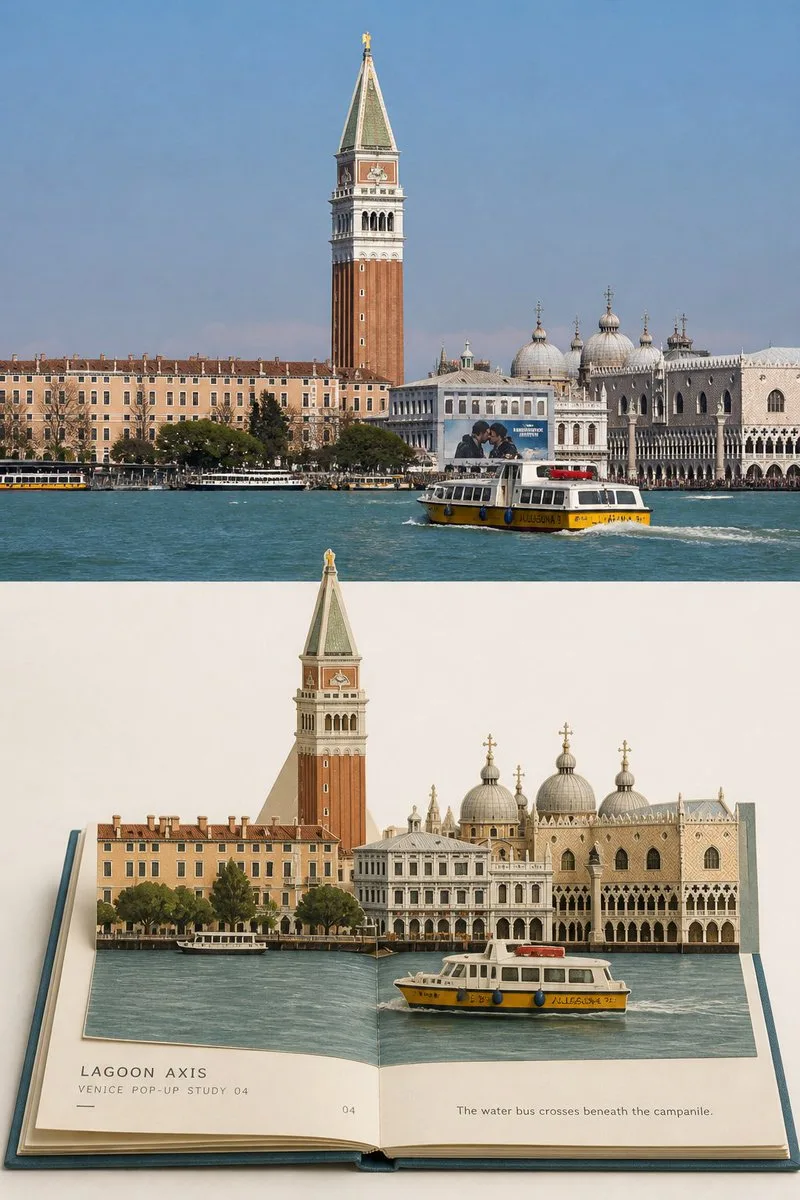
ChatGPT
DesignChatGPT
Travel pop up city book photo poster prompt
Creator @Hamburgerai
Prompt
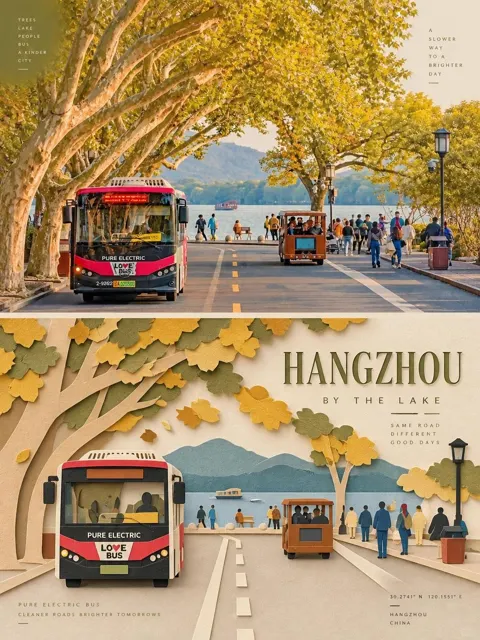
Please turn each travel photo I upload into an independent **TRAVEL POP-UP CITY BOOK | 旅行城市立体书** high-end travel photo transformation poster.

Output each photo separately; multi-photo collages are prohibited.

The overall composition uses a 3:4 vertical layout, consisting of two areas: "Real Original Photo" and "Physical Pop-up Book Transformation." By default, the top and bottom each occupy about 50%, separated by a straight, clear horizontal boundary with no feathering, mixing, or paper structures crossing the boundary line.

## Top: Real Original Photo

Faithfully use the original photo at the top.

Accurately maintain the photo's:

- Location identity and core buildings
- Direction of rivers, canals, roads, or squares
- Outlines of bridges, towers, domes, and major buildings
- Left-to-right order and front-to-back occlusion between buildings
- Positions and directions of boats, vehicles, and a few people
- Topographic height, observation perspective, and spatial depth
- Real materials, natural light and shadow, and original color atmosphere

The top must clearly be presented as a real photographic work, rather than a re-generated realistic illustration.

Perform only slight and restrained color grading suitable for travel magazines, art publications, and photography exhibitions, and add a very thin, almost imperceptible film grain.

To adapt to the vertical frame, the sky, water, roads, and surrounding environment can be naturally cropped or extended, but buildings, bridges, boats, and figures must not be stretched, distorted, mirrored, moved, replaced, or redesigned.

## Bottom: Physical Hardcover Pop-up Book

The bottom uses a pure, warm-white empty space.

In the center of the empty space, place a fully opened, flat-lying collector-grade hardcover pop-up book. The pop-up book typically occupies 65%—85% of the width of the transformation area, with continuous and clean white space preserved around it.

Adopt a slightly frontal, slight top-down perspective so the viewer can simultaneously see:

- Hardcover cover
- Central spine and binding groove
- Left and right pages
- Stacked page edges
- Cover wrapping edges
- Paper thickness
- A three-dimensional scene rising from the pages

The cover color is extracted from the deepest and most stable colors in the original photo, such as deep blue, ink green, charcoal gray, ochre brown, or dark red.

The book block uses warm ivory white thick paper.

It must look like a physical pop-up book that can indeed be closed, rather than a common paper carving base, flat illustration, or architectural model.

## City Distillation

Select 3—8 elements from the original photo that best prove the identity of the location, such as:

- Core buildings or landmarks
- Rivers, canals, roads, or squares
- Recognizable towers, roofs, or domes
- Bridges or arches
- Waterfront buildings
- Boats, vehicles, or a few people
- A set of architectural layers that establish foreground-background relationships

Maintain the left-to-right order, architectural height, traffic direction, front-to-back occlusion, and observation angle from the original photo.

Actively delete:

- Dense window panes
- Repetitive roofs
- Complex signs
- Large numbers of tourists
- Fine vegetation
- Small ripples on the water
- Irrelevant street facilities
- Architectural details that do not help identify the location

Do not add landmarks, character costumes, cultural symbols, or a second city not present in the photo just to make the pop-up book look rich.

## Pop-up Book Layering

According to the photo structure, organize the same location into a paper art structure with clear foreground, middle, and background layers.

### Low-layer Pages

Rivers, canals, roads, squares, or the ground unfold along the central spine, becoming the low-layer paper surface connecting the left and right pages.

The water surface can be represented by a continuous piece of gray-blue, blue-green, or deep-green printed paper, which must cross the spine and continue the spatial direction of the original photo.

### Middle-layer Structures

Main building groups, waterfront facades, bridges, trees, or street blocks rise from the middle-layer pages.

Buildings do not need to copy all windows; keep only:

- Main outlines
- Roof directions
- Key openings
- Facade proportions
- A few representative window panes
- The location's most recognizable colors

### Back-layer Structures

Towers, bell towers, domes, castles, mountains, or the highest landmarks are placed in the back layer and become the highest vertical structures of the entire pop-up book.

High-layer structures must have reasonable fold lines, support pieces, or connection tabs, and must not look like suspended models.

### Front-layer Structures

Boats, vehicles, people, railings, or other scale references can become independent foreground fold pieces, rising from the pages closer to the viewer.

They should not form a second visual center but need to help establish the location's scale and spatial depth.

## Paper Art Mechanisms

Clearly express real, credible paper art construction:

- mountain folds
- valley folds
- scored fold lines
- die-cut edges
- paper slots
- insertion tabs
- connecting tongues
- hidden support pieces
- triangular rear braces
- layered cardstock
- central page hinge
- visible page thickness
- exposed paper fibers
- matte printed ink
- slight handmade registration errors

Bridges can span across the left and right pages and be supported by architectural paper layers or hidden support pieces on both sides.

Towers can be erected using a central vertical fold, slots, and rear triangular support pieces.

Boats, vehicles, and people can be connected to the pages using independent small fold pieces.

There should be clear front-to-back hierarchy and contact shadows between buildings, but shadows must be slight, real, and consistent with paper thickness.

Do not use huge suspended structures that cannot be realistically folded or cannot close the book.

## Colors

Extract colors entirely from the original photo and compress and soften complex colors into a limited printed paper palette.

Prioritize preserving:

- Identification colors of buildings and landmarks
- Roof colors
- Water colors
- Vegetation colors
- Neutral stone colors
- An accent color for a boat, door/window, or vehicle

Use neighboring colors such as warm ivory white, gray-blue, earth red, olive green, ochre brown, and stone gray to unify the rest.

All colors should appear as matte printed paper, dyed cardstock, or slightly aged ink, rather than plastic, resin, or smooth 3D materials.

Avoid high-saturation children's toy colors, neon colors, and fixed palettes unrelated to the photo.

## Small Text System

Add a small amount of English text related to the location structure on the edges of the blank pages.

Each usually contains:

1. A structural title of 1—3 English words
2. A line for the location and series number
3. An observation sentence of 6—14 English words

For example:

`CANAL FOLD`
`VENICE POP-UP STUDY 01`
`The water becomes the hinge between two rows of walls.`

Or:

`RIALTO ARCH`
`VENICE POP-UP STUDY 02`
`The bridge rises while the gondola slips below.`

Titles should describe spatial structures actually existing in the photo, such as:

- `CANAL FOLD`
- `BRIDGE LAYER`
- `LAGOON AXIS`
- `TOWER RISE`
- `WATERFRONT PAGE`
- `CITY HINGE`

When the location is reliable, write:

`VENICE POP-UP STUDY 01`

When the location cannot be reliably confirmed, use:

`CITY POP-UP STUDY 01`

Observation sentences only describe buildings, water bodies, boats, roads, directions, or spatial relationships actually present in the photo, and do not fabricate character stories, dates, coordinates, or building names.

Text must look like a native part of the pop-up book:

- Small serif, narrow sans-serif, or simple type
- Graphite gray, deep blue-gray, or ink the same color as the cover
- Slight letterpress, debossing, or paper ink absorption effects
- Arranged along page edges, the spine, or the low-layer water axis
- Clearly legible, but not as large titles

The total text area does not exceed 5% of the page area.

At most, add one page number, one short horizontal line, or one very small binding field.

Do not add author names, accounts, signatures, logos, QR codes, websites, fictional brands, or garbled code.

## Overall Vibe

The final image is like a travel chapter in a collector-grade architectural paper art book:

The real photo records how the city looked at the time,
The open book refolds canals, roads, bridges, and buildings into a space that can be preserved.

High-end, quiet, precise, gentle, with the temperament of architectural firm publications, art book fairs, independent travel magazines, and paper art collectibles.

## Forced Avoidance

Avoid:

missing original-photo comparison,
multiple-photo collage,
flat illustration printed on open pages,
ordinary paper collage,
single-layer paper silhouette,
origami terrain,
paper-clay model,
plastic 3D,
resin miniature,
realistic architectural model,
children’s toy book,
invented landmark,
mixed cities,
different location on each page,
incorrect building order,
missing central spine,
missing page edges,
missing fold lines,
impossible floating structure,
book filling the entire lower field,
no surrounding negative space,
desk props,
hands,
bookshelf,
room mockup,
large typography,
fake place names,
author name,
signature,
logo,
QR code,
watermark,
nonsense text.
Copy the text, add your own details, and try it in your image model.