Piko
Piko Explore prompt ↗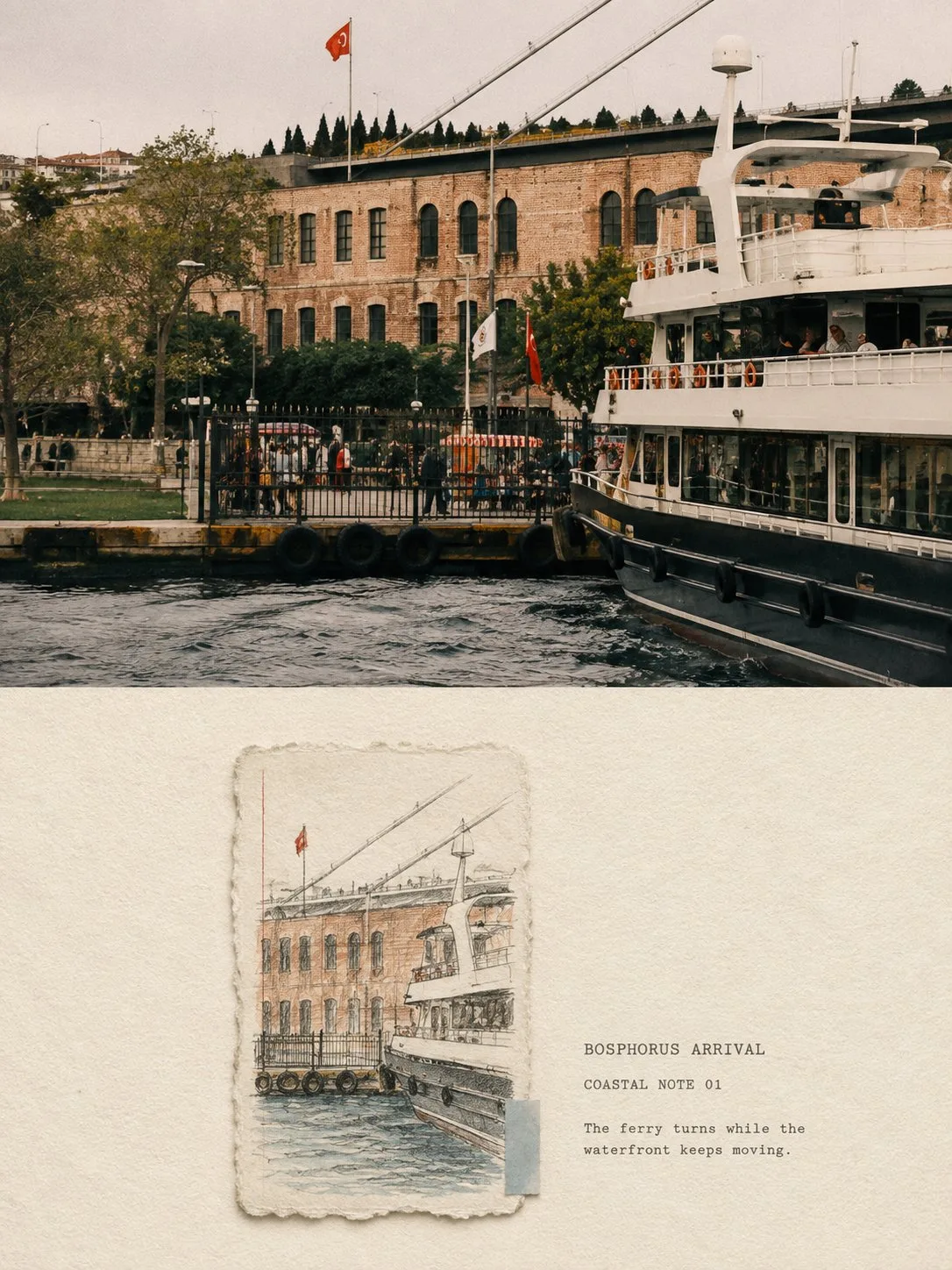
ChatGPT
DesignChatGPT
Paper window coastal memory travel poster prompt
Creator @Hamburgerai
Prompt
Please turn each travel photo I upload into an independent “PAPER WINDOW COASTAL MEMORY” high-end contrast poster. Output each photo separately, no multi-image collages.

The overall composition uses a 3:4 vertical layout. The upper original photo accounts for about 48%–50% of the frame, and the lower Paper Window Memory area accounts for about 50%–52%. Use a clear, straight, and restrained horizontal boundary between the two areas, without gradients, feathering, or overlapping.

The upper part must use the original photo itself, accurately maintaining the identity and number of subjects, the poses of people or animals, the direction of ships, the outlines of buildings, the mountain and coastlines, spatial relationships, viewing angles, natural textures, real light and shadow, and the original color atmosphere.

Apply only slight travel art publication-level color grading and extremely thin film grain. To adapt to the vertical format, you may reasonably crop or naturally extend the sky, water, ground, and environment without subjects, but do not stretch, distort, move, replace, or redraw the subject, and do not use AI-reconstructed similar photos to pose as the original.

The lower part uses a large area of warm off-white rough-textured watercolor paper as a complete background, retaining clearly visible cotton paper fibers, paper teeth, and slight natural color variations.

The large area of white space in the lower part is the main component of the composition; do not use maps, stamps, shells, tape, or decorative journal materials to fill the paper.

Place a small, vertical or nearly vertical hand-drawn paper sketch with naturally torn edges in a position slightly to the left or slightly off-center in the lower part.

The small sketch typically occupies only about 38%–45% of the width and about 45%–58% of the height of the lower part; at least 45%–60% of continuous, quiet, unpainted rough paper white space must be reserved around it.

The torn edges have real cotton paper fibers and slight physical thickness, using only soft, restrained contact shadows. Do not make it into thick cardboard, a 3D photo frame, a Polaroid photo, or a floating card.

Inside the small sketch, extract only one core travel anchor point most worth remembering from the photo, such as a boat, a windmill, a group of domes, a lighthouse, a section of a pier, a seaside building, or a pedestrian.

Pair it with two to four necessary environmental clues, such as a small stretch of shoreline, a strip of water, a few masts, a mountain ridge, a few rooftops, or plants. Proactively delete crowds, repeated boats, dense buildings, signs, window panes, clutter, and photographic noise.

Do not shrink the entire photo and draw it completely into the paper window, and do not follow the original photo's complete cropping, subject proportions, and information density.

Readjust the scale of the subject, the position of secondary elements, and the proportion of paper white space so that the core object feels like a separately preserved observation rather than a colored pencil copy of the photo. The interior of the sketch also retains obvious uncolored areas, with brushstrokes stopping naturally before reaching the torn edges.

The drawing medium is mainly hesitant, slender graphite pencil lines with slight manual errors, combined with dry colored pencils, light watercolor pencils, local paper surface scratches, and broken strokes.

The color scheme is entirely extracted from the original photo and summarized into a limited palette, such as the grayish-blue and turquoise of the sea and sky, the warm stone and ochre colors of buildings and land, the grayish-green of plants, and one very small characteristic color from the original image.

Colors remain soft, faded, and have a slight sense of old travel sketches; do not use high-saturation colors to fill the entire sketch.

Add an extremely thin, slightly faded red or warm-colored pencil vertical line to the edge of the small sketch, along with a small piece of grayish-blue, turquoise, or warm-gray paper fragment extracted from the photo's colors.

These elements are only used to establish the editorial rhythm of the paper and must not become a fixed brand logo or obstruct the subject.

By default, the lower part includes a small amount of accurate and clearly readable English text, placed in the continuous white space to the right of or near the small sketch. The text includes:

1. A scene or imagery title consisting of 1–3 English words;
2. A field similar to “COASTAL NOTE 01” or “TRAVEL NOTE 01”;
3. A short observation sentence of 5–12 English words, describing the weather, actions, buildings, boats, seawater, or spatial relationships that actually exist in the photo.

Text uses restrained typewriter serif, old lead type, or thin scholarly font, with slightly wide letter and line spacing, allowing for slight ink deficiency and uneven pressure at the edges, as if printed directly on rough paper.

The main title must be clearly recognizable at normal chat preview sizes and should not be shrunk into a gray decorative line. Do not fabricate cities, dates, coordinates, quotes, or historical information on your own.

Overall temperament is quiet and gentle, with a real paper touch and a sense of looking back after travel. The upper part retains the light and sound while the journey was happening; the lower part is like picking an object from memory and redrawing it on a small piece of paper tucked into a book.

Avoid:
The lower part completely redrawing the original scene;
Material replacement with the same cropping and same scale;
Full-surface watercolor background;
Giant hand-drawn sketches;
Multiple torn-paper cards;
Dense journal collages;
Smooth vector line art;
Children's cartoons;
Commercial travel icons;
Accumulation of maps, stamps, shells, and tape;
Heavy drop shadows;
Plastic 3D;
Fake Chinese, gibberish;
Author names, signatures, logos, QR codes, URLs, and watermarks.
Copy the text, add your own details, and try it in your image model.