Piko
Piko Explore prompt ↗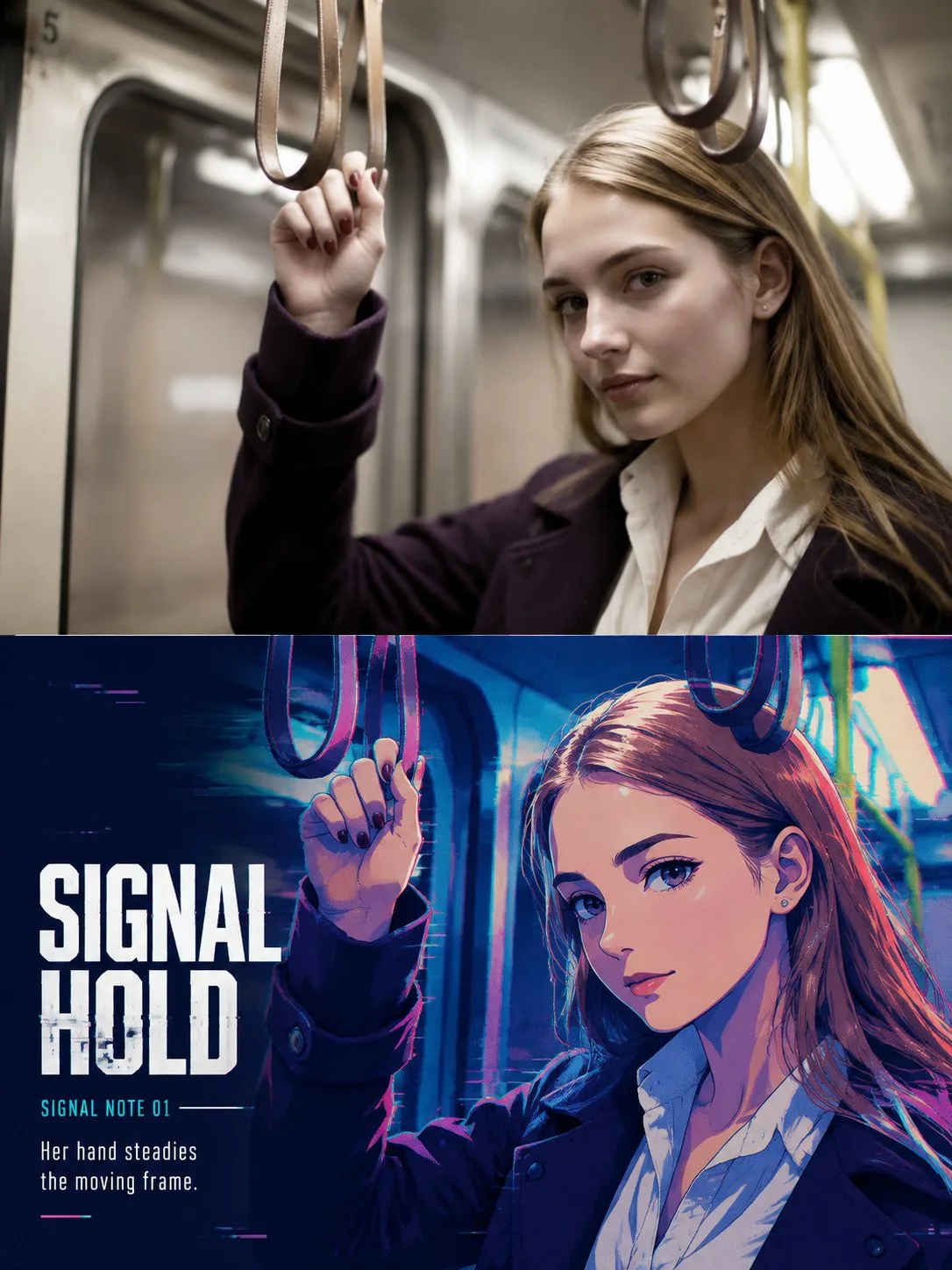
ChatGPT
DesignChatGPT
Neon glitch anime travel diptych poster
Creator @Hamburgerai
Prompt
Please turn each character photo I upload into an individual high-end travel portrait editorial poster, no multi-image stitching, output each photo separately. Overall use a 3:4 vertical diptych composition, with the top retaining the clearly visible real original image and the bottom performing a "neon glitch anime portrait" redraw; the upper and lower borders are horizontal, clear, and restrained, with no atomization or mutual penetration.

The upper part accounts for about 45%–50% of the frame, faithfully retaining the original photo. Accurately maintain character identity, quantity, face shape, facial feature relationships, hairstyle, glasses, gaze, expression, posture, gestures, clothing, personal items, and the spatial relationship between characters and the environment. Only perform slight art magazine-style color grading and extremely thin film grain processing, it must still clearly be real photography. To adapt to the frame, the sky, walls, or surrounding environment can be naturally extended, but the character must not be redrawn, faces changed, stretched, mirrored, copied, or the subject moved.

The lower part extracts the most recognizable face, hairstyle, clothing, gestures, and key items of the character from the same photo, reconstructing them into a contemporary anime editorial portrait with strong visual impact. Do not copy the full framing and background density of the original photo; significantly enlarge the character's half-body to occupy about 65%–95% of the lower area's width, which can be moderately cropped out of the frame, letting the line of sight, action direction, and silhouette become dominant. The background retains only one to three architectural lines, lights, railings, furniture, or spatial structures from the original image, compressed into low-information light-color fields and structural fragments.

The redraw uses angular color blocks, clear anime line-plane relationships, deep indigo shadows, steel blue and cyan highlights, and selects one existing warm color from the original image to translate into a restrained coral pink or magenta accent color. Add limited halftones, partial RGB color offset, edge signal breaks, and a small amount of pixel chunks. Glitch effects can only occur at hair edges, shoulder silhouettes, clothing outer edges, and background structures, and must not cover or destroy faces, eyes, hands, and key items; must not change character identity, nor generate irrelevant cyber cities.

The lower area retains about 18%–28% of continuous deep blue or low-information color surface as a breathing area. The text is concentrated into a group, the main title uses bold narrow game title fonts that are clearly readable in normal chat previews, with slight pixel cuts or RGB misalignments; auxiliary fields are smaller, but cannot be shrunk into gray lines.

Extract a 1–3 English word title based on the actually visible location, character state, action, or light in the photo, and add the field "SIGNAL NOTE 01" and a 5–12 English word observation sentence. If the location cannot be confirmed, do not fabricate place names, the title "AFTERLIGHT" can be used, and the observation sentence "A quiet face held inside moving light." Only render confirmed text, do not add author names, brands, accounts, logos, QR codes, or garbled characters.

The overall color is extracted from the original photo and compressed into a limited palette, maintaining the original warm and cold character of the character's clothing and environment. The image should have a sense of real travel atmosphere, anime character tension, video game cover feel, and editorial publication restraint; glitch is rhythm, not obstruction.

Avoid generic cyberpunk, full-screen neon rainbows, dense HUD, UI text too small to read, vaporwave templates, facial glitches, extra limbs, cheap filters, and full-frame illustrationization.
Copy the text, add your own details, and try it in your image model.