Piko
Piko Explore prompt ↗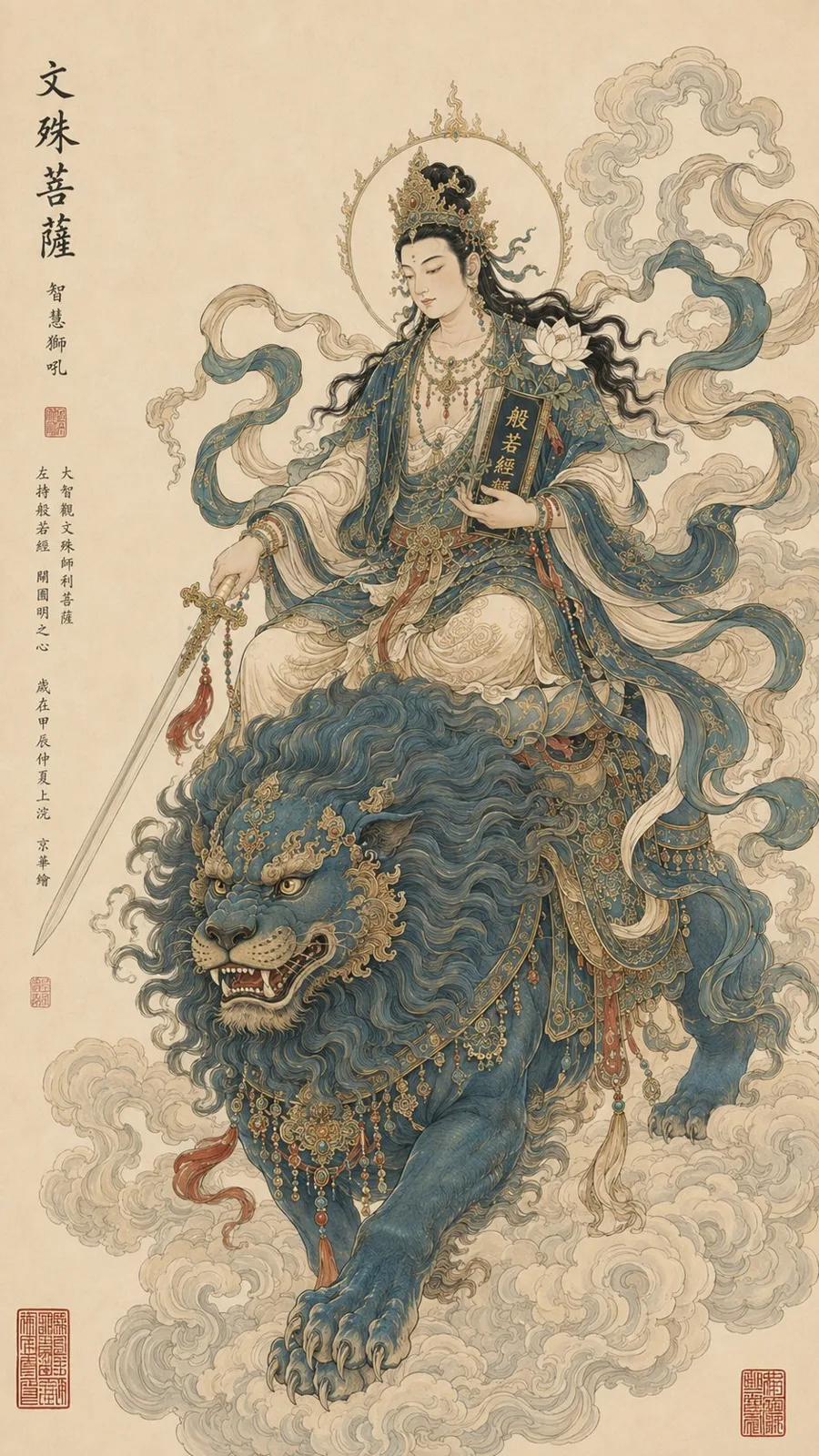
ChatGPT
IllustrationChatGPT
Eastern deity gongbi heavy color icon illustration
Creator @MrLarus
Prompt
【Deity Identity】: Manjushri Bodhisattva / Virupaksha (Wide-eyed Heavenly King) / Vajrapani / Samantabhadra Bodhisattva / Other deities
【Divine Beast / Dharma Tool】: Blue Lion / Crimson Dragon / Vajra Scepter / Six-tusked White Elephant / Others
【Core Action】: Sitting upright on a beast / Standing in suppression / Stepping on clouds / Surrounding / Holding a dharma tool
【Main Color Palette】: Azurite, pale green, cinnabar, old gold, ink blue, ivory white
【Composition Method】: Top and bottom dual subjects / S-shaped surrounding / Frontal suppression / Diagonal momentum
【Overall Temperament】: Solemn, sacred, powerful, eerie, majestic
【Aspect Ratio】: 9:16

Generate an illustration of an Eastern deity's Gongbi heavy-color sacred icon, with [Deity Identity] as the core subject, combined with [Divine Beast / Dharma Tool] to establish a complete, clear, and powerful compositional relationship. The figures, divine beasts, dharma tools, silk ribbons, and clouds together form a clear visual "momentum," but the subject hierarchy must be distinct, avoiding all elements competing for the screen at the same time.

The overall style merges the temperament of traditional Chinese deity paintings, Gongbi heavy color, fine-line ink engraving, and ancient sacred icon scrolls. The figure's appearance is solemn, possessing divinity and a sense of pressure. The attire adopts a complete system of traditional divine robes, armor, crowns, and jade ornaments, with patterns mainly consisting of cloud patterns, scale patterns, hui-style patterns, grass scrolls, lotus patterns, and beast-face patterns.

Focus on maintaining "high-continuity Gongbi line drawing": Figure hair, beards, divine beast fur, dragon manes, feathers, etc., must follow the direction of natural growth and volume, shaped with long, smooth, continuous, and stable lines; silk ribbons, sleeves, dragon bodies, elephant trunks, and clouds use complete S-shaped and C-shaped large curves, clearly coherent from start to finish. Reduce fine, fragmented textures; do not use random short lines, dense broken dots, jagged hair, noise-like engraved lines, or meaningless small patterns.

Armor, crowns, attire, and divine beast decorative patterns should be "few but complete," prioritizing the use of complete, closed large patterns and continuous border decorations. Complexity comes from clear structural layers, not a large number of miniature fragmented patterns.

Color uses low-saturation but full, uniform, and continuous traditional mineral heavy colors, with [Main Color Palette] as the core. Azurite, stone green, ink blue, old gold, bronze gold, cinnabar, ochre red, ivory white, and other colors form clear large color blocks. Colors in the same area are stable and complete, with depth changes naturally transitioning according to the structure. Avoid random mottling, fading, stains, particles, artificial aging, and uneven color blocks.

The background uses clean, warm ivory-colored Xuan paper, retaining only extremely light natural paper fibers, with large areas of white space and a small amount of continuous line-drawn clouds. The ancient charm comes from Gongbi lines, mineral coloring, Xuan paper, calligraphic inscriptions, and red seals, without relying on artificial aging.

The image must include a traditional ancient painting inscription system: one column of medium-sized deity names, one column of smaller sub-titles, a small amount of fine inscriptions, and 3–5 red seals of staggered sizes. The text is part of the visual structure but must not overpower the figures and divine beasts, nor should it be made into modern poster-style large titles.

The overall principle follows "high density for the subject, low density for the background": Figure faces, divine beast heads, dharma tools, and core armor areas have the richest detail; large robes and divine beast bodies maintain medium density; clouds and the Xuan paper background are the sparsest.
Copy the text, add your own details, and try it in your image model.