Piko
Piko Explore prompt ↗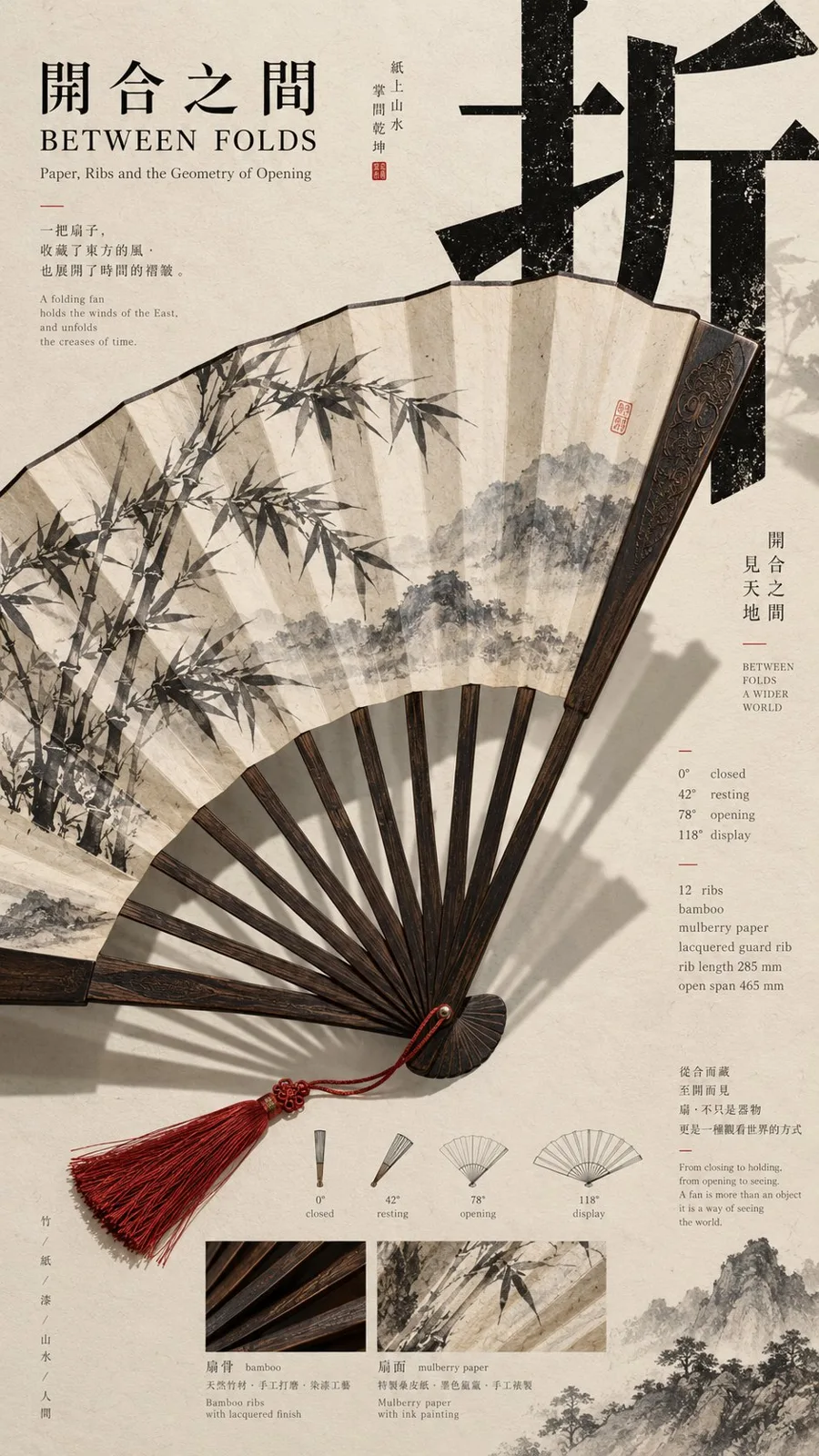
ChatGPT
DesignChatGPT
East asian museum publication poster design
Creator @MrLarus
Prompt
[Theme]:
[Main Visual Subject]:
[Chinese Core Character]:
[Chinese Title]:
[English Title]:
[Subject Characteristics]: Unfolding / Hanging / Curling / Layering / Vibrating / Projection / Reflection / Other
[Archival Information]: Structure / Material / Dimensions / Process / Local Sample / Other
[Theme Color]:
[Aspect Ratio]: 9:16

Generate a vertical poster with a mature East Asian Editorial Design, Museum Poster, and cultural publication texture.

Adopt a "non-balanced three-part composition," letting the screen respectively carry the main visual, title text, and auxiliary archival information, but do not divide it equally into three areas, and do not have obvious columns.

First analyze the most recognizable real physical or material characteristics of the [Main Visual Subject], and then let this characteristic directly determine the composition. For example, unfolding generates radiation, cloth hanging and curling forms depth, material sections reveal internal layers, and string vibrations form continuous trajectories. Do not mechanically apply cases; redistribute the most suitable visual movement according to the current object.

The subject must occupy a large visual weight and span at least two regions. Connect the main visual, Typography, and information areas through occlusion, interweaving, projection, curling, sections, extensions, vibrations, or other real spatial relationships, rather than placing the three parts separately.

Set a striking [Chinese Core Character], using modern high-contrast Songti / Mincho typeface, making the text itself part of the composition. Allow the subject to pass through the text, text to undergo black-white inversion after crossing different materials, shadows to cover text, or structural lines to enter the negative space of the character, but always ensure the core character is clearly readable.

Overall, use warm ivory uncoated art paper as the base, paired with ink black text and one primary [Theme Color]. Try to keep only one strong emphasis color per work. The paper has a slight fiber and matte printing texture, keeping it clean without severe aging.

Add [Archival Information] truly related to the theme, such as material, structural section, production process, dimensions, motion state, local macro, or time record. Use Grotesk / Monospace for small information and Serif for English titles. All text should serve the theme of the work, without using template placeholders like Design Study, Visual System, Vol., Case, etc.

Information density is kept medium to high, but do not spread it evenly. The main visual forms a high-density area, and the structure and archives form a medium-density area, while retaining about 20%–30% effective white space to form a clear dense-sparse rhythm.

Final reading order: First see the huge subject and core Chinese; second discover the spatial or motion relationship formed by the subject crossing regions; third understand the structure, material, or production process; fourth read the work title and archival details.

The same series has a unified paper, font system, information hierarchy, and editorial temperament, but each piece is redesigned according to different [Subject Characteristics] for the three-part direction, visual momentum, and cross-region methods, rather than template reskinning.

Avoid: even three columns, PPT feel, ordinary product photography, full-page images with titles, random small text, meaningless English, tech HUD, excessive aging, Logo, QR code, numbering, and copyright markings.
Copy the text, add your own details, and try it in your image model.