Piko
Piko Explore prompt ↗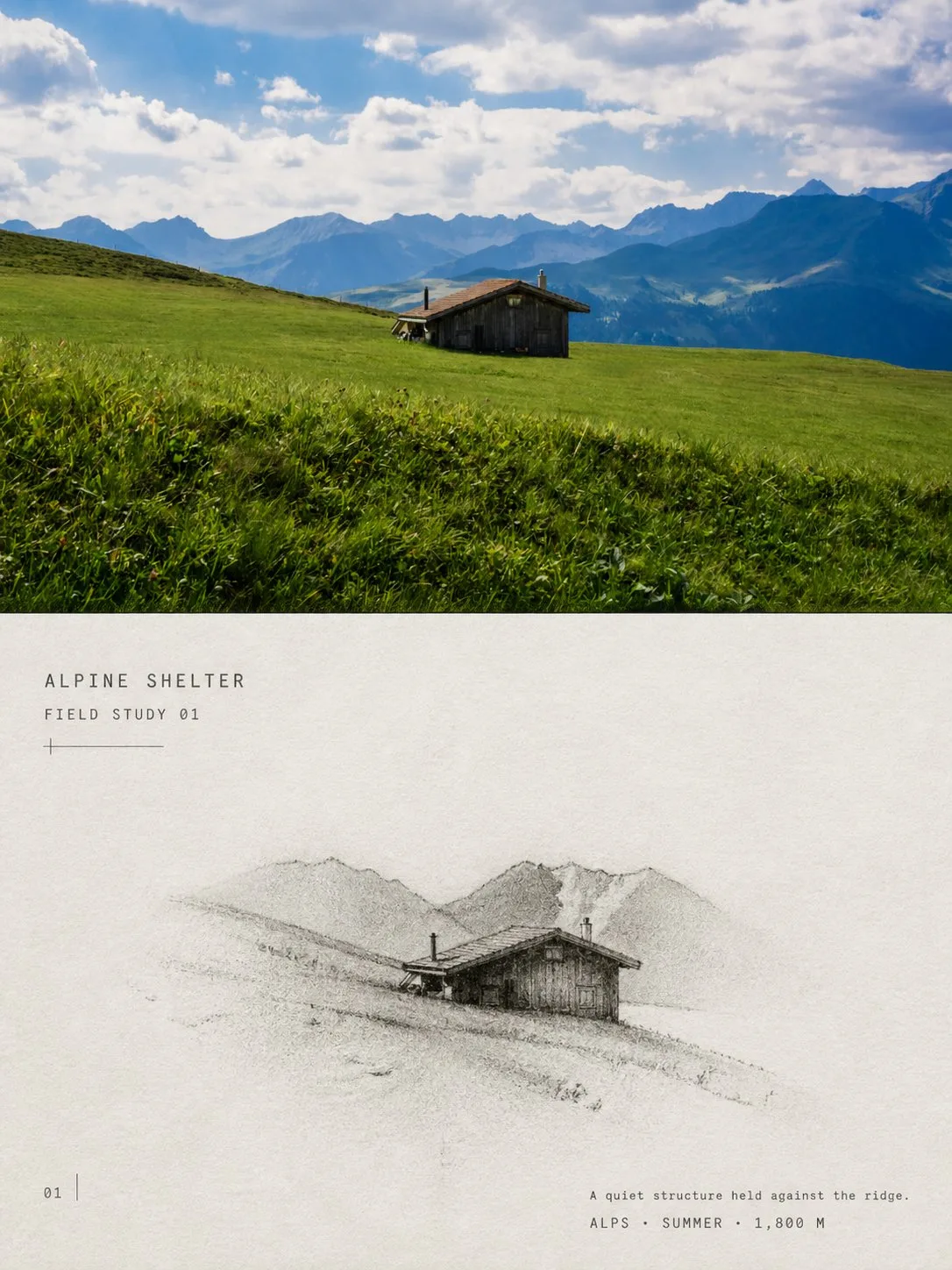
ChatGPT
DesignChatGPT
Charcoal vanishing travel study poster
Creator @Hamburgerai
Prompt
Please turn each travel photo I upload into an independent "CHARCOAL VANISHING TRAVEL STUDY" high-end comparison poster. Output each photo separately, no multi-image collages.

Overall 3:4 vertical composition, consisting of two areas: the real original photo and a charcoal re-drawing. Clear boundary, restrained composition, but no need to mechanically pursue perfectly equal proportions. By default, let the upper real photo occupy about 48%—52%, and the lower charcoal study occupy the remaining space.

【Top: Real Original Photo】
Faithfully preserve the original photo at the top. Accurately maintain the subject's identity, quantity, posture, action direction, terrain structure, architectural outline, spatial relationship, natural light and shadow, real materials, and original color atmosphere. The viewer must clearly see that this is an original photo, not a re-drawn realistic illustration. Perform only slight and delicate photographic color grading to give the photo the texture of an independent travel magazine, art publication, or photography exhibition, and add an extremely thin, almost imperceptible film grain. To adapt to the vertical format, you may naturally crop or extend the sky, ground, mountains, and surrounding environment, but do not stretch, distort, move, replace, or redesign the subject.

【Bottom: Charcoal Vanishing Study】
First, understand the visual anchor points in the photo most worth remembering. It could be a lonely house, a car, a boat, a small bridge, a person, an animal, a single tree, a flight of steps, or a recognizable architectural structure. Do not convert the entire photo completely into a black and white charcoal drawing. Actively delete a large amount of information in the sky, forests, mountains, roads, grass, tourists, and buildings, keeping only the minimum elements necessary to maintain the subject's identity, posture, spatial direction, and travel memories. Shrink the extracted subject to form a concentrated, isolated charcoal study on paper. The subject and its necessary environment usually occupy only about 18%—35% of the lower half, with large areas of complete, un-drawn warm white sketchbook paper remaining around it. Environment should keep at most 1—3 sets of suggestive marks, for example: a disconnected patch of ground or hillside, a small piece of rock wall, two or three strokes of a ridge, a cable, a few tree hints, a contact shadow, a set of short spatial scuffs. Do not draw a complete background.

【Charcoal Material】
Use real willow charcoal, compressed charcoal, and mix in a tiny amount of graphite marks: willow charcoal, compressed charcoal, charcoal pencil, graphite accents, broad directional charcoal marks, finger-smudged gray, kneaded eraser lifting, broken contours, charcoal dust, loose charcoal crumbs, visible paper tooth, uneven hand pressure, dry powdery residue. Use broad, short, directional charcoal marks to build the weight of the subject, rather than using a lot of fine pencil cross-hatching. The deepest charcoal black is only used for the most recognizable structures of the subject, such as door openings, under eaves, car windows, silhouettes, animal horns, dark parts of a boat hull, tires, landing points, or key structural joints. Use one to two finger-smudged gray areas to establish volume, and retain smudge marks, charcoal dust particles, eraser highlights, paper grain breakage, and uneven pressure.

【Vanishing Method】
The center and key structures of the subject are relatively clear, while the outer edges gradually lose integrity: clear charcoal marks → broken outlines → loose scuffs → scattered charcoal dust → un-drawn paper. Vanishing must come from the artist not finishing the drawing, charcoal dust being smudged away, outlines being lifted by an eraser, and brushstrokes stopping naturally. Do not use digital transparency, soft focus, smoke, lens blur, airbrush, feathered masks, or smooth gradients to create the vanishing effect. Let the unfinished parts truly stop in the paper, presenting a feeling of "memory appearing and also leaving".

【Color and Paper】
The lower half strictly adopts a restrained monochromatic system: warm white paper, warm gray, cold gray, charcoal black, a tiny amount of graphite silver-gray. Do not keep the colors of the photo below. Do not add fixed accent colors. Paper should have a delicate but clearly visible natural texture: warm, matte, slightly rough, able to see paper tooth, fibers, and charcoal friction marks. By default, do not add titles, explanatory text, numbers, or logos, allowing the charcoal subject and paper white space to complete the narrative independently.

【Overall Temperament】
Overall it is like a saved page from a travel observation manual: the real photo records the scenery seen at the time, and the charcoal study leaves the part remembered later. Quiet, restrained, lonely, tactile, with a slight sense of the passage of time, possessing the archival quality of high-end art publications, travel archives, and museum sketchbooks.

Avoid: complete charcoal landscapes, full-photo black and white filters, academic detailed sketches, photo-realistic pencil drawing, dense hatching, complete backgrounds, oversized subjects, digital airbrushes, smooth shadows, smoke dissipation effects, watercolors, ink bleeding, oil paintings, collages, decorative borders, templated layouts, irrelevant text, logos, and watermarks.
Copy the text, add your own details, and try it in your image model.